Yellow Diamond
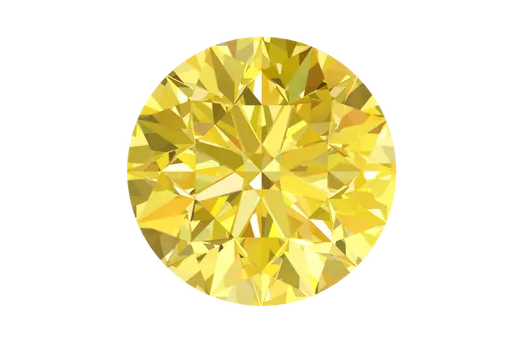
A yellow diamond's yellow comes from nitrogen, the most common fancy diamond and the best entry point. From pale yellow to the top "Canary" Fancy Vivid Yellow, the range is vast.
A yellow diamond is pure carbon (hardness 10), its yellow from traces of nitrogen. It is the most common fancy diamond, and so the most affordable and entry-level — from pale yellow to the top “Canary” Fancy Vivid Yellow, the range is vast. Natural versus treated, and the fancy grade, decide its value.
About Yellow Diamond
A yellow diamond is a diamond bearing traces of nitrogen; nitrogen absorbs blue-violet light and turns it yellow, the most common fancy diamond. Almost every diamond holds a little nitrogen; when nitrogen gathers in a particular form, it absorbs blue-violet light and casts the diamond yellow. The pale ones belong to the common “Cape series”, while those concentrated into a pure golden yellow leap to the prized Fancy Vivid Yellow (nicknamed Canary). The same yellow, a hair’s breadth apart, can differ several-fold in worth.
Why Choose a Yellow Diamond
A yellow diamond is the best entry into fancy diamonds — warm and golden as sunlight, festive and endearing, and relatively affordable. In the often astronomically priced world of fancy diamonds, yellow, being relatively plentiful, is the most approachable, offering the uniqueness of a coloured centre stone for a reasonable sum. That bright, warm gold is especially loved by Chinese buyers for its festive meaning; the famous Tiffany Yellow Diamond adds a layer of elegant imagination.
History & Famous Stones
Yellow is the most plentiful of the fancy colours, and its name is tied to South Africa — the pale yellows of the Cape Province gave the “Cape series” its name. Its most famous stones span fashion and legend:
- The Tiffany Yellow Diamond: 128.54 carats (cut from a 287.42-carat rough found at Kimberley, South Africa, in 1877), worn in over a century by only a handful of women — Audrey Hepburn, Lady Gaga (2019 Oscars) and Beyoncé among them.
- The Incomparable: 407.48 carats, Fancy Deep Brownish Yellow, cut from an 890-carat rough found by a child in Mbuji-Mayi, DR Congo — one of the largest fancy diamonds ever.
- The Allnatt: 101.29 carats, Fancy Vivid Yellow, named after its former owner Alfred Allnatt.
The Truth About Yellow Diamond
A yellow diamond is priced on the GIA fancy grade (Fancy → Vivid) and whether it is natural; pale yellow is cheap, a rich pure Vivid Canary dear, and HPHT / irradiation can add yellow artificially.
- Truth one: the yellow comes from nitrogen. This is the line between it and colourless diamonds (D–Z on the 4Cs) — past Z, you enter the world of “fancy yellow”.
- Truth two: the fancy grade jumps the price. Fancy Light → Fancy → Intense → Vivid (Canary), the richer and purer the dearer; a single grade can multiply the price.
- Truth three: the most affordable fancy diamond. Compared with pink, blue and green, yellow is more plentiful and the first choice for an entry fancy diamond.
- Truth four: natural versus treated. HPHT or irradiation can “wash” a yellowish diamond into a yellower, purer stone, worth less than natural — confirm by GIA certificate.
Yellow Diamond on the Market
There are natural yellow diamonds, treated yellow (HPHT / irradiation), yellow lab-grown and yellow sapphire / CZ posing; the key is the GIA natural colour and fancy grade.
| Type | Traits | Price | How to tell |
|---|---|---|---|
| Natural yellow diamond | Nitrogen colour, Fancy grade | High–affordable | GIA “Natural” + fancy grade |
| Treated yellow (HPHT / irradiation) | Artificially yellowed | Low | Certificate reads “Treated” |
| Yellow lab-grown | Laboratory | Low–mid | Girdle “LABORATORY-GROWN” |
| Yellow sapphire / CZ posing | Not diamond | Very low | Hardness, fire, certificate |
Before You Buy
Buying a yellow diamond means reading the GIA fancy grade (Vivid is dearest) and whether it is natural; you can start at Fancy / Fancy Light, and guard against HPHT / irradiation treatment.
- Get a GIA (or equivalent) certificate, confirming natural status and fancy grade.
- For entry, Fancy Light / Fancy yellow offer good value; for the top, look for Fancy Vivid (Canary).
- Check that the yellow is pure — a green or brown tinge lowers the value.
- Guard against added-yellow treatment and lab-grown sold mixed in — rely on the certificate.
FAQ
Where does a yellow diamond's yellow come from?
From traces of nitrogen in the crystal — nitrogen absorbs blue-violet light and makes the diamond yellow; the richer and purer, the more prized.
Is yellow the cheapest fancy diamond?
Relatively, yes. Yellow diamonds are more plentiful than pink, blue or green, the most affordable and entry-level fancy diamond; but a top Fancy Vivid Yellow is still prized.
What is a Canary yellow diamond?
A pure, rich Fancy Vivid Yellow, bright as a canary — the top colour among yellow diamonds.
Could a yellow diamond be treated?
Yes. HPHT or irradiation can make a yellowish diamond yellower and purer, worth less than natural — confirm "natural" by GIA certificate.
How do I choose a yellow diamond?
First the GIA natural status and fancy grade, then the purity of the yellow; for entry, Fancy / Fancy Light offer value, and for the top, look for Vivid Canary.