
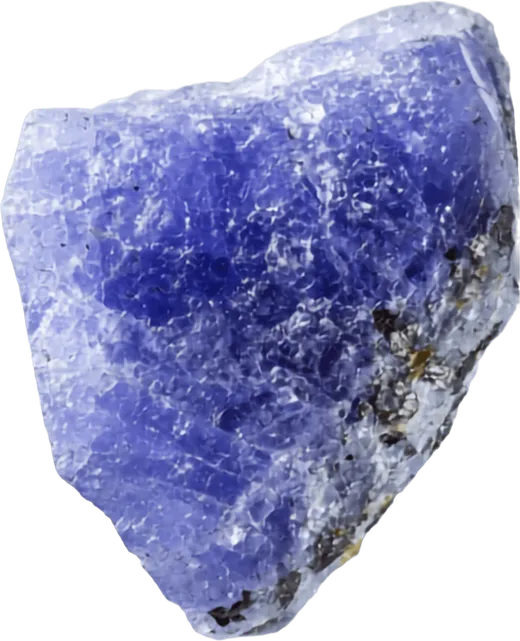
Tanzanite
Only one mining area in the whole world, in Tanzania, produces it — far rarer than diamond, yet far softer too, and in need of gentle care.
Tanzanite is the blue-violet variety of zoisite, Mohs hardness 6–7, produced only around Merelani in Tanzania. About 99% is heated from brownish-yellow to blue-violet — the norm. It is December’s birthstone, soft and with cleavage, better as a pendant or earrings than a daily ring.
About Tanzanite
Tanzanite is the blue-violet variety of zoisite, coloured by traces of vanadium, discovered only in 1967 near Merelani in northern Tanzania, still the world’s only source. It shows trichroism — from different angles you see blue, violet, and a wine-red or brownish green. Mohs hardness is only 6–7, with one direction of perfect cleavage.
Why Choose a Tanzanite
Tanzanite is December’s birthstone, its blue shot through with violet like dusk, and produced by a single mining area on earth — the rarity is itself the story. Its blue-violet is a colour no other blue stone quite reproduces. With supply dwindling, it is the singular choice for those who love that dreamlike colour — so long as you wear it with the care owed to something fragile.
History & Famous Stones
Tanzanite’s story is only a few decades old, yet full of legend — in 1967, Maasai tribesmen found blue crystals at Merelani, in the foothills of Kilimanjaro, and a prospector brought them to the world. One discovery, one name:
- The 1967 discovery: Maasai herders picked up blue crystals and told the prospector Manuel d’Souza, nicknamed “Mad Manuel”; he first took them for sapphire, until the GIA confirmed a new variety of zoisite.
- Tiffany and the name: in 1968, Tiffany & Co. saw its promise and — finding “blue zoisite” too close to “suicide” — named it “tanzanite” after its origin, Tanzania; a single campaign made its name overnight.
The Truth About Tanzanite
About 99% of tanzanite is heated from brownish-yellow to blue-violet, which is normal; it has a single source worldwide, and is soft, cleaved and easily damaged.
- Truth one: heating is the norm. The rough is mostly brownish-yellow and turns blue-violet only after heating at about 500–600°C; unheated stones are the rare exception.
- Truth two: a single source worldwide. Only Merelani in Tanzania produces it, far rarer than most prized gemstones.
- Truth three: soft, cleaved, easily damaged. At just over six in hardness, a knock in the cleavage direction can split it — not for a daily ring.
- Truth four: trichroism shapes the cut. Cut orientation decides whether the stone reads more blue or more violet, affecting both beauty and price.
Tanzanite on the Market
The mainstream is heated stones (normal); what to guard against are coating-enhanced stones and synthetic imitation.
| Type | Traits | Price | How to tell |
|---|---|---|---|
| Natural · heated | Blue-violet, stable colour | Mainstream | Standard; certificate notes heating |
| Natural · unheated | Uncommon | Premium | Needs a reliable certificate |
| Coating-enhanced | Surface-deepened blue-violet | Low | Coating wears; visible under a loupe |
| Synthetic / glass | Flat colour | Low | Certificate, inclusion traits |
Before You Buy
Accept that heating is the norm and guard against coating; it is soft and brittle, better as a pendant or earrings, and never in ultrasonic or steam.
- Heating is normal, no cause for hesitation; but guard against coating-enhanced stones.
- Soft and brittle: better as a pendant or earrings than a ring, and clear of knocks and thermal shock.
- Clean only with warm water and a soft cloth, never ultrasonic or steam (it can split along the cleavage).
- Colour: the deeper the blue-violet the dearer; check whether it leans blue or violet in daylight.
FAQ
Is tanzanite always heated?
About 99% is — the rough is mostly brownish-yellow and turns blue-violet only after heating. This is the trade norm and legitimate; unheated stones are rare and carry a premium.
Can I wear a tanzanite ring every day?
Not advisable. At only 6–7 with perfect cleavage, it chips easily on impact; better as a pendant or earrings, with a ring worn occasionally and clear of knocks.
Where does tanzanite come from?
Only the Merelani area of Tanzania, discovered as recently as 1967 — the world's only source.
How do I clean tanzanite?
Warm water and a soft cloth only; never ultrasonic or steam, and avoid sudden temperature change.
Is tanzanite worth buying?
If you love that blue-violet and understand its rarity and delicacy, yes; but it is soft, better worn as a treasure than used roughly every day.