
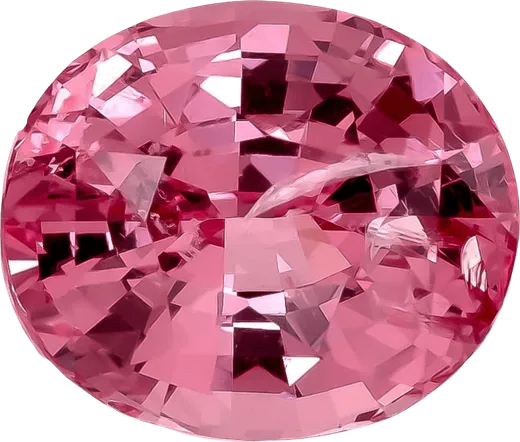
Spinel
Many famous "rubies" in history are in fact spinels. It glows a moving red, and is usually beautiful by nature and untreated — a stone underrated for centuries.
Spinel is a distinct mineral, coloured red by chromium, growing alongside ruby in the same rock and nearly indistinguishable by eye, Mohs hardness 8, and usually natural and untreated. Many famous “rubies” in history are in fact spinels. It is an August birthstone (added in 2016), and a stone underrated for centuries.
About Spinel
Spinel is a distinct mineral, turned red by chromium — the same colouring element as ruby — hardness 8, and the two often grow side by side in the same rock. Beyond red, there is pink, orange, purple and the rare cobalt blue. Precisely because it grows with ruby and is hard to tell apart by eye, it was mistaken for centuries.
Why Choose a Spinel
Spinel has a ruby-like deep red, yet is usually natural and untreated — a connoisseur’s favourite; it is an August birthstone (added in 2016). The neon pink of Mahenge (Tanzania), the deep red of Myanmar, and cobalt-blue spinel have all climbed in price lately — to choose it is to choose a quiet expertise, and a story of being mistaken for centuries.
History & Famous Stones
Spinel is history’s most famous “impostor” — several celebrated stones set in crowns as rubies are in fact spinels. Three crown stones tell the whole mistaken tale:
- The Black Prince’s Ruby: a 170-carat red spinel set at the front of the British Imperial State Crown above Cullinan II, one of the oldest gems in the Crown Jewels, its history reaching back to the mid-14th century, from Badakhshan in Afghanistan.
- The Timur Ruby: a 361-carat red spinel inscribed with the names of Mughal emperors, also part of the British Crown Jewels.
- The Samarian Spinel: 500 carats, the largest known spinel, part of the Iranian Crown Jewels, bearing a 400-year-old inscription of the Mughal emperor Jahangir.
The Truth About Spinel
Spinel was taken for ruby for centuries (the Black Prince’s Ruby is in fact a spinel); fine red spinel is mostly wholly natural and untreated; origin drives the value.
- Truth one: it was taken for ruby for centuries. The “Black Prince’s Ruby” and the “Timur Ruby” in the British crown are in fact spinels.
- Truth two: mostly wholly natural. Unlike ruby and sapphire, which are routinely heated, fine red spinel is almost entirely untreated.
- Truth three: red spinel and ruby need chemical analysis to confirm; but spinel is singly refractive and ruby doubly refractive — one clue to telling them apart.
- Truth four: origin drives the value. Famous sources like Mahenge and Mogok climb in price year by year.
Spinel on the Market
Tell apart natural spinel (mostly untreated), synthetic flame-fusion spinel, and blue glass / treated stones posing as the rare cobalt blue.
| Type | Traits | Price | How to tell |
|---|---|---|---|
| Natural · untreated | Deep red / pink / blue | High | Mostly natural, singly refractive |
| Synthetic spinel (flame-fusion) | Common in old birthstone rings | Low | Certificate, inclusion traits |
| Sold as “ruby” | Mistaken for ruby | — | Spinel’s single refraction tells |
| Cobalt blue spinel | Rare cobalt blue | High | Certificate vs blue glass |
Before You Buy
Spinel being mostly natural and untreated is its selling point, but still ask for a certificate (especially red and cobalt blue); confirm natural versus synthetic.
- It is mostly natural and untreated — a strong reason to choose it; but still ask for a certificate, especially for red and cobalt blue.
- Confirm natural versus synthetic — synthetic spinel is common in older jewellery and old birthstone rings.
- At hardness 8 with no obvious cleavage, it takes daily wear well; warm water and a soft brush.
- If you love ruby’s red but want natural and untreated, spinel is an honest, rewarding choice.
FAQ
How do you tell spinel from ruby?
By eye it is very hard, and the two often grow together in the same rock; spinel is singly refractive, ruby doubly refractive, and spinel is usually natural and untreated — to be certain, use a laboratory.
Is spinel an imitation of ruby?
No. It is a distinct and precious mineral, only long mistaken for ruby (the "Black Prince's Ruby" is in fact a spinel).
Does spinel need heating?
Fine red spinel is almost entirely natural and untreated — the crystal is already clean and vivid enough, which is its reassurance.
What is the "Black Prince's Ruby"?
A famous stone in the British crown, long taken for a ruby but in fact a spinel — the celebrated example of spinel being mistaken.
Is spinel durable?
At hardness 8 with no obvious cleavage, it takes daily wear well; warm water and a soft brush will clean it, though still avoid heavy blows.