
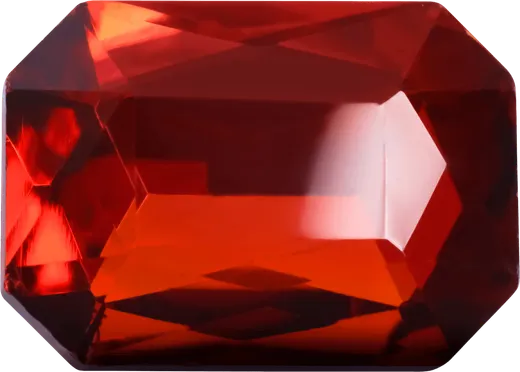
Ruby
Within the corundum family, only the red is called ruby — a large, clean natural ruby is rarer than a diamond of the same grade. Yet behind the single word "ruby" lies more than the eye can read.
Ruby is red corundum, Mohs hardness 9 — the only red member of the corundum family. Its value turns less on size than on origin and treatment: heating is an accepted norm, while lead-glass filling is another matter entirely, and worth far less. Here is the whole picture — from identity and reasons to buy, to the insider truths, the market reality and care.
About Ruby
Ruby is red corundum (aluminium oxide), coloured by traces of chromium; within corundum, only the red is called ruby — every other colour is a sapphire. It is the same mineral as sapphire, parted only by the trace elements it carries. The more chromium, the deeper the red; yet chromium, as the crystal forms, also draws in fractures and inclusions. So a natural ruby that is at once large, red and clean is born rare — rarer, grade for grade, than a diamond. Exactly where pink ends and red begins is a line each laboratory still draws a little differently.
Why Choose a Ruby
Ruby is July’s birthstone and the stone of the 15th and 40th wedding anniversaries — a symbol of love and strength, and at hardness 9, hard-wearing enough for daily wear. Red is our most primal colour — blood, fire, heartbeat, passion; the name itself comes from the Latin ruber, meaning red. In Chinese gift-giving, where meaning matters, that true red reads as festive and momentous — one of the few coloured centre stones you can give without a misstep. The finest colour is called “pigeon’s blood”: a pure, faintly purplish deep red set against strong red fluorescence, seeming to glow from within under sunlight — the grade you collect and pass down.
History & Famous Stones
Ruby has been called the “king of gemstones” (Sanskrit ratnaraj) since antiquity, and the pigeon’s-blood reds of Mogok, Burma have been pursued by emperors and Mughal royalty for centuries. Its most famous stones tell the whole story of that red:
- The Sunrise Ruby: 25.59 carats, Burmese pigeon’s blood, sold at Sotheby’s Geneva in 2015 for US$30.4 million — the most expensive ruby, and the most expensive coloured gemstone (fancy diamonds aside) ever sold at auction, at a record price per carat.
- The Rosser Reeves Star Ruby: 138.7 carats, a Sri Lankan star ruby with a sharp, well-defined star — one of the most famous star rubies in the world, now in the Smithsonian.
The Truth About Ruby
With ruby, origin and treatment matter more than size: heating is an accepted norm, while lead-glass filling is another thing altogether, and worth far less.
- Origin and treatment outweigh carats. Rubies from the marble of Mogok, Burma — high chromium, low iron, pure red, strong fluorescence — set the world’s standard; Mozambique now yields reds to rival them at a gentler price. For the very same colour, a single origin report can move the price several-fold.
- Heating is not filling. Honestly declared, heating is legitimate trade; what you must tell apart is “heated only” versus “heated and filled”.
- Guard most against lead-glass filling (composite ruby). Fractured, near-worthless rough is flooded with lead glass to pass as a clear “ruby”; the value is a world apart, and the stone fears acid, heat and ultrasonic cleaning.
- Unheated, with a top origin report, is auction territory — the premium can multiply.
Ruby on the Market
What is sold as “ruby” is not one thing but several — natural, heated, lead-glass filled, synthetic, imitation — and prices can differ a hundredfold; the certificate is what settles it.
| Type | Traits | Price | How to tell |
|---|---|---|---|
| Natural · unheated | Natural colour + origin report | Highest | Report reads “no heat” |
| Natural · heated | Standard, more even colour | High | Report reads “heated” |
| Lead-glass filled | Big fractures filled, see-through | Low | Loupe shows gas bubbles + blue-purple flash |
| Synthetic (flame-fusion) | Too perfect, too red | Very low | Curved growth lines (natural shows angular colour banding) |
| Imitation | Spinel / garnet / glass, matched by colour | Varies | Certificate, refractive traits |
The “Black Prince’s Ruby” in the British crown is in fact a spinel; “pigeon’s blood” now has defined colour standards from Gübelin and Lotus, yet every seller on the street will call their stone one — a label, in the end, is not a certificate.
Before You Buy
Before buying a ruby, first ask “is it filled?”, get a certificate that states treatment and origin, and remember that a filled ruby must never meet ultrasonic cleaning or acid.
- Open with a single question: “Is it filled?” Heating is acceptable; lead-glass filling is far cheaper, and another matter entirely.
- Insist on a certificate, and read the treatment and origin closely.
- “Pigeon’s blood” — trust the certificate, not the sales pitch.
- A filled ruby must not go into an ultrasonic cleaner or touch acid — remind your jeweller before any repair or cleaning.
- Keep this in mind: a large, clean natural ruby is inherently rare and will not be cheap; a “big ruby” at an unbelievable price usually has a story behind it.
FAQ
How do you tell a ruby from a red spinel?
By eye, it is very hard — the two often grow side by side in the same rock. Spinel is singly refractive, ruby doubly refractive, and spinel is usually natural and untreated. To be certain, you need a laboratory.
Can I wear a ruby every day?
Yes — at hardness 9, second only to diamond, it is hard-wearing. But a lead-glass filled ruby is fragile and dislikes acid, heat and ultrasonic cleaning, so both wear and repair call for care.
What is "pigeon's blood", and is it worth chasing?
It names a pure, faintly purplish deep red with strong red fluorescence — the top colour, now given clear definitions by Gübelin and Lotus. Prized, yes, but confirm it by certificate, not the seller's word.
Do I always need a certificate to buy a ruby?
When origin, "unheated" status or a high price is involved, a certificate is essential. It states the treatment (heating or filling) and the origin — which is exactly what a ruby's value rests upon.
How do I clean and care for a ruby?
A natural or heated ruby takes warm water and a soft brush; a lead-glass filled ruby must never meet an ultrasonic cleaner or acid. Store it apart from other stones to avoid knocks.