
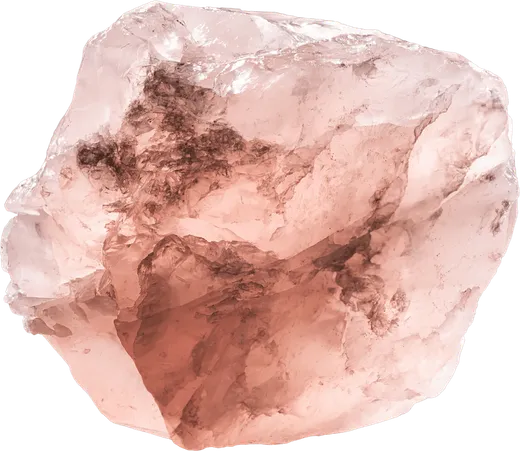
Rose Quartz
Its pink comes from countless nanoscale fibres within — that soft, misty translucency is its nature, not a flaw.
Rose quartz is pink quartz, Mohs hardness 7. Its pink comes from countless nanoscale fibrous inclusions within, so it is mostly translucent with a soft haze — this is its nature, not a flaw. Fine stones occasionally show a six-rayed star (asterism).
About Rose Quartz
Rose quartz is pink quartz, its pink from countless nanoscale fibrous inclusions within, hardness 7 with no cleavage, mostly translucent with a soft haze. Light scatters through those fibres into a gentle pink. For the same reason, rose quartz is rarely fully transparent like rock crystal — the haze is its nature.
Why Choose a Rose Quartz
Rose quartz is the gentlest of stones, long tied to love and to healing, a tender choice for yourself or someone you love, and affordable too. It can be made into carvings, bead strands or simple jewellery. Fine rose quartz occasionally shows asterism: under a light, six rays of a star seem to float.
History & Famous Stones
Rose quartz is one of humanity’s oldest gems, and its oldest “stone of love” — from Mesopotamia in 7000 BCE to the weddings of Greece and Rome, it has always been tied to love. One ancient history, one myth:
- The oldest use: as early as 7000 BCE, artisans in Mesopotamia (today’s Iraq) shaped rose quartz into beads and amulets; ancient Egyptians wore it for protection, and Greeks and Romans carved it into seals to authenticate documents.
- Love and myth: Greeks and Romans gave rose quartz as a wedding gift symbolising reconciliation and enduring love; one Greek myth even tells that when Aphrodite was wounded saving her beloved Adonis, their mingled blood stained white quartz rose-pink.
The Truth About Rose Quartz
A soft, translucent haze is the norm (not second-rate); massive rose quartz is colour-stable; asterism appears occasionally; the rare “crystalline rose quartz” is light-sensitive and pales slowly.
- Truth one: a soft translucent haze is the norm. Its inner fibres keep it from full clarity; the haze is not a defect but the way it is.
- Truth two: massive rose quartz is colour-stable. Under normal daylight it does not fade easily.
- Truth three: occasional asterism. Fine stones with directional fibres show a six-rayed star under a light — a rare bonus.
- Truth four: there is also a rare “crystalline rose quartz”. Unlike the common massive kind, this rare transparent rose quartz is light-sensitive and pales slowly.
Rose Quartz on the Market
Tell apart natural rose quartz, dyed quartz and glass imitation, and see through “love energy” price patter.
| Type | Traits | Price | How to tell |
|---|---|---|---|
| Natural rose quartz | Soft pink, translucent, stable colour | Affordable | Natural haze |
| Dyed quartz | Too even, too vivid | Low | Dye pools in the fractures |
| Glass imitation | Gas bubbles | Low | Feel, hardness |
| ”Love energy” patter | Mysticism inflating price | — | Unrelated to gemmology |
Before You Buy
Do not take rose quartz’s haze for second-rate (it is its nature); massive rose quartz is colour-stable, and a clear, vivid “rose quartz” is worth asking whether it is dyed.
- Do not mistake the haze for second-rate — it is its nature; an even, soft pink wears best.
- Massive rose quartz is colour-stable; if a “rose quartz” is unusually clear and vivid, ask whether it is dyed.
- For the star effect, check it under a light.
- Hard, no cleavage — warm water and a soft brush; still avoid long sun.
FAQ
Why is rose quartz misty, not clear?
That is its nature — the pink comes from nanoscale fibrous inclusions, which make it mostly translucent and soft, not second-rate.
Does rose quartz fade?
Common massive rose quartz is colour-stable and does not fade easily; but a rare "crystalline rose quartz" is light-sensitive and pales slowly in long sun.
How do you tell dyed rose quartz?
Dyed stones are too even and vivid, or the dye pools in the fractures; natural rose quartz is soft and even, with a natural haze.
Does rose quartz show a star?
Fine rose quartz with directional fibres can show a six-rayed star (asterism) under a light — a rare bonus.
How do I care for rose quartz?
Warm water and a soft brush; it is hard with no cleavage, but still avoid prolonged sun.