
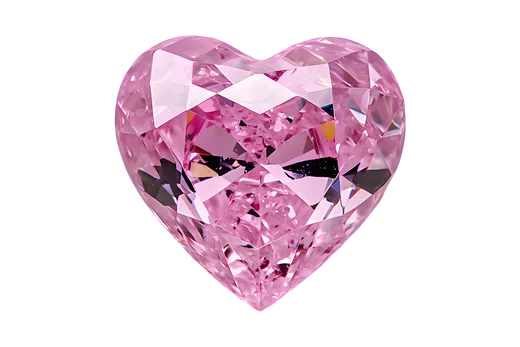
Pink Diamond
A pink diamond's colour is not an impurity but crystal lattice twisted under pressure deep in the earth — which is why it is so rare. The Argyle mine is closed, and supply will only shrink.
A pink diamond is pure carbon (hardness 10), but its pink comes not from an impurity but from the crystal lattice being twisted under pressure deep in the earth (plastic deformation) — which is why it is so rare. The Australian Argyle mine, which supplied about 90% of the world’s pink diamonds, closed in 2020, and prices keep rising. Natural versus treated is the key to buying.
About Pink Diamond
A pink diamond is a diamond (pure carbon, hardness 10), its pink caused by the lattice being twisted under pressure deep in the earth (plastic deformation), not by an impurity. Most fancy diamonds owe their colour to trace elements (nitrogen in yellow, boron in blue), but pink and red are the exception — their colour comes from atomic-lattice slippage as the diamond bears extreme pressure and heat underground. Because the cause is so unusual, pink diamond sits at the rarest end of all diamonds.
Why Choose a Pink Diamond
A pink diamond is the height of rarity and romance: about 90% of the world’s came from a single now-closed mine, and the rarity is itself the legend. That blush of pink, soft but not weak, is a collector’s and heirloom choice, and the most prized statement in an engagement ring. Australia’s Argyle mine supplied about 90% of the world’s pink and red diamonds for decades, yet closed permanently in 2020 as its deposit ran out — which means top pink diamonds will only grow scarcer.
History & Famous Stones
The legend of the pink diamond is bound to Australia’s Argyle mine — opened in the 1980s and the source of about 90% of the world’s pinks, it closed in 2020, making the great stones rarer still. The most valuable stones in auction history are, more often than not, pink:
- The CTF Pink Star: 59.60 carats, Fancy Vivid Pink, sold at Sotheby’s Hong Kong in 2017 for US$71.2 million — still the most expensive diamond ever sold at auction (cut from a 132.5-carat rough).
- The Winston Pink Legacy: 18.96 carats, vivid pink, sold for US$50.7 million in 2018.
- The Graff Pink: 24.78 carats, sold for US$46 million in 2010, once the record for a pink.
The Truth About Pink Diamond
A pink diamond is priced on the GIA fancy grade (Fancy → Intense → Vivid) and “natural colour”; irradiation or HPHT can create pink artificially, worlds apart in value.
- Truth one: the colour comes from lattice distortion. Unlike yellow and blue, pink (and red) diamonds owe their colour not to an impurity but to the physical distortion of a pressured crystal — which makes them inherently rare.
- Truth two: Argyle is closed, and supply dwindles. This Australian mine once supplied about 90% of the world’s pink and red diamonds and closed in 2020; top pink diamonds climb in price year by year.
- Truth three: the fancy grade sets the price. GIA grades colour intensity from Fancy Light to Fancy Vivid / Deep; the richer, the rarer and dearer, and even a small stone can be very costly.
- Truth four: natural versus treated is the life-or-death line. Irradiation and HPHT can turn an ordinary diamond pink, worth a fraction of natural — always confirm the “natural colour origin” by GIA certificate.
Pink Diamond on the Market
There are natural pink diamonds, treated ones (irradiated / HPHT), pink lab-grown and coated / poor stones; prices differ several-fold, and the key is a GIA natural-colour certificate.
| Type | Traits | Price | How to tell |
|---|---|---|---|
| Natural pink diamond | Natural colour, Argyle etc. | Highest | GIA certificate reads “Natural” |
| Treated pink (irradiated / HPHT) | Artificial colour | Low | Certificate reads “Treated / Irradiated” |
| Pink lab-grown | Laboratory, same composition | Low–mid | Girdle “LABORATORY-GROWN” |
| Coated / dyed poor stone | Surface colour, wears off | Very low | Loupe shows colour not going in |
Before You Buy
Buying a pink diamond demands a GIA certificate confirming the “natural colour origin”, reading the fancy grade (Fancy Vivid is dearest), and guarding against irradiated / HPHT treatment and lab-grown sold mixed in.
- Insist on a GIA (or equivalent) certificate, confirming the colour is “natural” and not treated.
- Read the fancy grade: Fancy Light → Intense → Vivid → Deep, the richer the dearer.
- Understand that even a small stone can be very costly — a pink diamond’s worth is in colour and rarity, not size.
- Natural, treated and lab-grown can look nearly identical — only the certificate proves it.
FAQ
Why is a pink diamond so expensive?
Its pink comes from a rare lattice distortion, not an impurity, so it is inherently rare; and with the Argyle mine (about 90% of world supply) closed, top pink diamonds will only grow scarcer and dearer.
Is a pink diamond dyed?
A natural pink's colour is inborn; but the market does have irradiated or HPHT-treated pink diamonds, worth far less, to be told apart by GIA certificate.
What is Argyle?
A diamond mine in Australia that supplied about 90% of the world's pink and red diamonds for decades, permanently closed in 2020 when the deposit ran out — the key to rising pink-diamond prices.
Lab-grown pink diamonds are much cheaper — worth buying?
Lab-grown pinks are identical in composition to natural and affordable, suited to those who want the pink itself rather than rarity and resale; but they lack a natural pink's scarcity value, so read the girdle inscription.
How do I choose a pink diamond?
Look first at the GIA "natural colour" and fancy grade, then at whether the pink is pure; even a small stone can be very costly, so spend within reason and rely on the certificate.