Peridot
The green is not lent by an impurity but is the colour of its own substance — peridot is one of the few "self-coloured" stones that need almost no treatment.
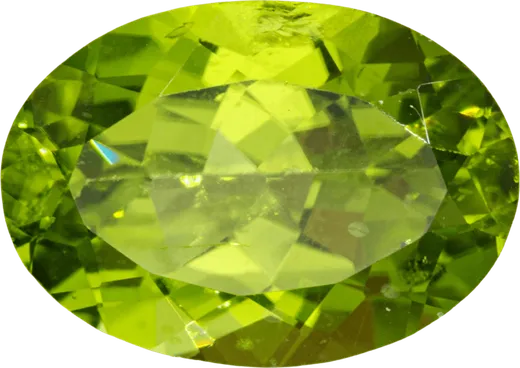
Peridot is the yellow-green gem variety of olivine, Mohs hardness 6.5–7. Its green comes from iron in its own structure — an inborn self-colour — so it needs almost no treatment. It is August’s birthstone, affordable, but soft and a little brittle, and asks to be treated gently.
About Peridot
Peridot is gem-grade olivine (magnesium-rich forsterite), its yellow-green coloured by its own iron, which gemmology calls “idiochromatic” (self-coloured). Mohs hardness 6.5–7, with a single colour range — from pale yellow-green to deep olive, depending on iron content. One of the few “one stone, one colour” gems, its green is bright and alive.
Why Choose a Peridot
Peridot is August’s birthstone, a symbol of abundance and positive energy; it wears especially well in candlelight and warm light, earning the name “the emerald of the evening”. Needing almost no treatment, steady in supply and affordable, it is the fresh choice for those who want a natural green without the price of emerald.
History & Famous Stones
Peridot was ancient Egypt’s “gem of the sun” — over three thousand years ago, Egyptians gathered this green on a Red Sea island, believing it drove away the terrors of the night. One island, one mystery, tell its antiquity:
- Zabargad (St. John’s Island): this small Red Sea island, known in antiquity as Topazios, was the ancient world’s main source of peridot, worked as early as 1500 BCE; legend says it was infested with snakes until a pharaoh drove them into the sea.
- The mystery of Cleopatra’s “emeralds”: some historians believe part of Cleopatra’s famed “emerald” collection was in fact peridot — through the Middle Ages the two were still often confused.
The Truth About Peridot
Peridot is almost never treated, its green a self-colour; but it is soft and a little brittle, fears acid and thermal shock — the keys to buying and care.
- Truth one: a self-coloured stone, beautiful as it is. Rarely heated or dyed — the green before you is usually its own.
- Truth two: concentrated sources. San Carlos in Arizona supplies 80–90% of the world; Pakistan and Myanmar also yield fine, large material.
- Truth three: soft and a little brittle. At only 6.5–7, long contact with skin oils and acids can etch the surface.
- Truth four: depth follows iron content, and a rich but not muddy green is dearer.
Peridot on the Market
What to watch for is glass imitation and mineral confusion; real peridot is almost never treated.
| Type | Traits | Price | How to tell |
|---|---|---|---|
| Natural peridot | Yellow-green self-colour, few inclusions | Reasonable | High refraction, oily lustre |
| Green glass | Flat colour, gas bubbles | Low | Loupe shows bubbles |
| Green topaz / chalcedony confusion | Similar colour | Varies | Different refraction and fire |
A note: green demantoid garnet looks similar, but is rarer, has greater fire, and costs more.
Before You Buy
Peridot is soft and a little brittle — avoid knocks, thermal shock and acids; clean only with warm water and a soft cloth, never ultrasonic.
- Almost no treatment — the reassuring reason to choose it.
- Colour: a bright yellow-green; avoid brownish or muddy stones.
- Keep it from perfume, sweat and acids — they etch the surface.
- Store it apart from harder stones to avoid scratches.
FAQ
Is peridot an emerald?
No. Both are green but different minerals — peridot is softer, more affordable and green-with-yellow; emerald is dearer and heavily included.
Can I wear peridot every day?
At only 6.5–7 and a little brittle, it suits earrings and pendants more than a daily ring; wear a ring only occasionally.
Does peridot need treatment?
Almost never — the green is a self-colour, and most on the market are natural, which is its reassurance.
How do I clean peridot?
Warm water and a soft cloth; never ultrasonic or steam, and avoid acids and sudden temperature change.
Where does peridot come from?
Arizona (USA) is the largest source; Pakistan and Myanmar (Burma) yield fine, large material.