
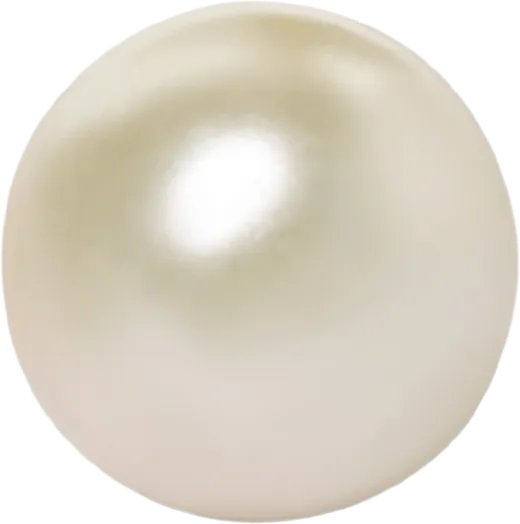
Pearl
The only gem grown by a living creature, and the softest of them all. In buying a pearl, what matters most is not size but the lustre, and how thick the nacre is.
Pearl is the only gem grown by a living creature, and the softest of them all (Mohs hardness 2.5–4.5). What matters most in a pearl is not size but lustre and nacre thickness — thin nacre peels and shows white within a few years. Over 99% on the market are cultured. It is June’s birthstone.
About Pearl
Pearl is not a mineral but is formed inside a mollusc, wrapped layer by layer in aragonite and conchiolin, Mohs hardness 2.5–4.5, the softest of gems; over 99% on the market are cultured. A grain of sand or a piece of tissue enters the shell, and the mollusc secretes layer upon layer around it, becoming a pearl over years. A truly wild natural pearl is so rare it appears almost only at auction.
Why Choose a Pearl
Pearl is June’s birthstone, the only gem that needs no cutting and is at its most beautiful from birth, and long a byword for “poise”. It has no fire, no sparkle — its beauty is a soft light glowing from within, and it suits skin tones beautifully. For a graduation, a milestone, a mother — many people’s first proper piece of jewellery is a pearl.
History & Famous Stones
Pearl is the only gem grown by a living creature, and one of the most storied jewels in history — seen from Spanish royalty to Hollywood. Two famous pearls, one small, one vast:
- La Peregrina (“the Wanderer”): found in 1513 in the Gulf of Panama by an enslaved diver, it passed through King Philip II of Spain and Queen Mary I of England; in 1969 Richard Burton bought it for US$37,000 for his wife Elizabeth Taylor, and in 2011 it sold at Christie’s for about US$11.8 million.
- The Pearl of Lao Tzu (Pearl of Allah): found in the 1930s inside a giant clam off Palawan in the Philippines, weighing about 6.4 kilograms — one of the largest pearls known.
The Truth About Pearl
Look at lustre before size; nacre thickness sets its lifespan; “natural” holds a trap — ask natural (wild) versus cultured.
- Truth one: look at lustre first. In a good pearl, you can see your own outline on its surface; this matters far more to price than a millimetre or two of diameter.
- Truth two: nacre thickness sets its lifespan. Thin nacre shows a shifting shadow (the bead core) when turned, and peels to white within a few years.
- Truth three: “natural” holds a trap. Cultured counts as natural against imitation; what to ask is natural versus cultured — a price gap of hundreds of times.
- Truth four: blemish, shape and colour rank after lustre and nacre.
Pearl on the Market
There are Akoya, South Sea, Tahitian and freshwater cultured pearls, plus dyed black and shell-bead imitations; the keys are wild versus cultured and nacre thickness.
| Type | Traits | Price | How to tell |
|---|---|---|---|
| Akoya cultured | Round, sharp lustre | Mid–high | Nacre thickness, origin |
| South Sea | Large, gold / white | High | Naturally not cheap |
| Tahitian black | Peacock-green / aubergine overtones | High | Natural overtones |
| Freshwater | Many shapes, high volume | Affordable | Common |
| Dyed black / shell-bead imitation | Too even, too perfect | Low | Flatly dead, no overtones, no surface grain |
Before You Buy
A pearl is most easily harmed by everyday life — remember “on last, off first”, and ask about natural / cultured and nacre thickness.
- Perfume, hairspray, sweat, cleaners and ultrasonic cleaners all etch it.
- One line is enough: on last, off first; wipe clean with a soft cloth before storing.
- Restring bead strands every year or two.
- Ask about natural / cultured and nacre thickness — these matter more than size to its value and lifespan.
FAQ
How do I choose a pearl?
Look first at lustre and nacre thickness, not size — the sharper the lustre and thicker the nacre, the more beautiful and lasting; a surface in which you can see your own outline is best.
Is a cultured pearl a fake?
No. Both cultured and natural are real pearls; what to ask is natural (wild) versus cultured — the price gap can be hundreds of times.
How do you tell a real black pearl?
A real Tahitian black pearl shows peacock-green / aubergine overtones; dyed or irradiated black pearls are flatly even, without overtones.
Why does a pearl yellow or peel?
Thin nacre shows white within a few years; contact with perfume, sweat and chemicals etches the surface and dulls the lustre.
How do I care for a pearl?
Put it on last, take it off first, keep it from perfume, chemicals and ultrasonic; wipe clean with a soft cloth after wear, and restring bead strands every year or two.