
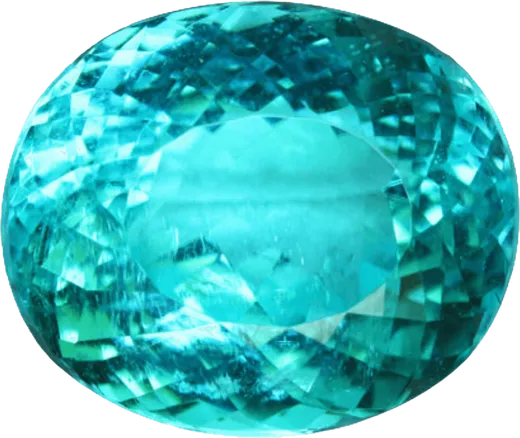
Paraíba Tourmaline
That neon, electric blue-green comes from copper, and no other stone can copy it — Paraíba is one of the gem world's modern legends.
Paraíba is copper- (and manganese-) bearing tourmaline (cuprian elbaite), Mohs hardness 7–7.5; that almost glowing neon blue and electric green come from copper, and no other stone can reproduce them. First found in Brazil in 1989, the name now covers copper-bearing tourmaline from any source; Brazilian material commands the highest premium, and authenticity and origin need a laboratory report.
About Paraíba
Paraíba is tourmaline bearing copper and manganese (cuprian elbaite); that neon blue-green comes from copper, and it is what sets it apart from every other blue-green stone. Mohs hardness 7–7.5. First discovered in the Brazilian state of Paraíba in 1989, later found in Nigeria (around 2001) and Mozambique (around 2003), the name “Paraíba” now refers to copper-bearing tourmaline from any origin.
Why Choose a Paraíba
Paraíba’s colour is the closest thing in the gem world to “glowing” — recognisable across a room, and a collector’s pursuit. Rare, dazzling, and carrying the legend of a modern discovery. If you seek something singular, a colour that cannot be replaced, Paraíba earns the title — provided your budget can match its rarity.
History & Famous Stones
The legend of Paraíba was written by one man’s obstinacy — the Brazilian prospector Heitor Dimas Barbosa, convinced a stone no one had ever seen lay beneath a small hill, dug from 1981 and waited nearly a decade, until in the autumn of 1989 he struck the first neon blue-green ever seen by human eyes. That colour, for its very scarcity, is legend:
- The discovery itself is the legend: Barbosa dug on instinct for almost ten years before Paraíba appeared; in his honour, the finest unheated material is called “Heitorita”.
- A large stone is near-myth: the fine material from Brazil’s Batalha mine mostly ran 0.15 to 0.75 carat, and anything over a carat is a rarity — all the large unheated Heitoritas ever found, it is said, could be held in two hands.
The Truth About Paraíba
Paraíba’s colour comes from copper, heating is common, origin swings the price hugely, and authenticity rests on laboratory chemical analysis.
- Truth one: the colour comes from copper. That neon owes itself to copper (Cu) and manganese (Mn).
- Truth two: heating is common. Most on the market are heated to bring out the blue-green; unheated stones, when noted on the certificate, earn a further premium.
- Truth three: origin swings the price hugely. Brazilian rough is nearly exhausted; for the same colour, Brazilian material often costs 30–50% more than African.
- Truth four: authenticity needs a laboratory. Origin and copper content are determined by chemical analysis (such as LA-ICP-MS) — for a stone this dear, a certificate is not optional.
Paraíba on the Market
Tell true copper-bearing stones from ordinary blue-green tourmaline trading on the name; it comes down to a lab report for copper content and origin.
| Type | Traits | Price | How to tell |
|---|---|---|---|
| Brazilian copper-bearing | Neon, electric, saturated | Highest | Origin report (LA-ICP-MS) |
| African copper-bearing (Moz. / Nig.) | Neon, slightly paler | High | Origin report |
| Ordinary blue-green tourmaline (by name) | No copper, flat colour | Low | Certificate confirming “copper-bearing” |
| Synthetic / treated | Too perfect | Low | Authoritative certificate |
Before You Buy
Buying Paraíba demands an authoritative certificate confirming “copper-bearing” and origin; heating is common and normal, and only unheated stones enjoy the extra premium.
- For a stone this dear, insist on an authoritative laboratory report confirming copper content and origin.
- Understand that heating is common and normal; only unheated stones carry the premium.
- Brazilian material commands more, but what matters is still that neon colour itself, before your eyes.
- Tourmaline is often included, so set and wear it clear of knocks.
FAQ
How do you tell Paraíba from ordinary tourmaline?
Paraíba contains copper and glows an electric blue-green; ordinary tourmaline has no copper and a flatter colour. To confirm the copper, you need a laboratory chemical analysis.
Does Paraíba need a certificate?
Yes. It is expensive, and authenticity, copper content and origin all need a laboratory (such as LA-ICP-MS) to determine. Without an authoritative report, stay away.
Is Brazilian material always better than African?
Brazilian material, for its history and saturation, often costs 30–50% more; but in the end it comes down to the neon colour and clarity of the very stone before you.
Is Paraíba treated?
Heating is common and normal; unheated stones, when noted on the certificate, carry an extra premium.
Is Paraíba durable?
At hardness 7–7.5 it is fair, but tourmaline is often included, so avoid knocks and wear it with care.