
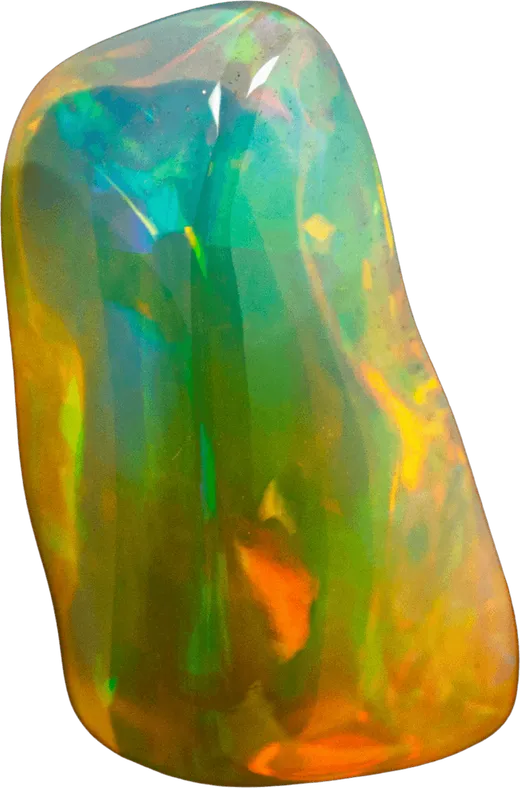
Opal
Among gemstones, the one most like a living painting — the play of colours within flows with the light. But it is fragile and water-bearing, to be treated with the tenderness owed to something that can crack.
Opal is hydrated silica, and its glory is the play-of-colour — the shifting spectrum flowing within. Mohs hardness 5.5–6.5, and holding a few percent of water; lose that water and it “crazes” irreversibly, making it one of the fragile ones. It is October’s birthstone.
About Opal
Opal is hydrated silica, not a crystalline mineral; countless tiny silica spheres in regular array diffract light into the play-of-colour, and opal that shows it is called precious opal. Mohs hardness 5.5–6.5, holding a few percent of water. Black opal’s dark body makes the spectrum vivid; fire opal’s orange-red is like a setting sun.
Why Choose an Opal
Opal is October’s birthstone, and the fire in every stone is unique — no two on earth are alike. That “one and only” quality is its most moving trait. It is best as a pendant or earrings, setting that flowing light where it is least likely to be knocked.
History & Famous Stones
Over 90% of the world’s opal comes from Australia, and that flowing spectrum has become several world-famous stones, each with its own story. Three great opals, each in its own right:
- The Olympic Australis: unearthed at Coober Pedy, South Australia, in 1956, weighing about 17,000 carats — the largest gem opal in the world, named for the Melbourne Olympics of that year.
- The Andamooka Opal: 203 carats, given to Queen Elizabeth II on her first visit to Australia in 1954, set into a necklace with 180 diamonds.
- The Aurora Australis: found at Lightning Ridge in 1938, 180 carats, a harlequin pattern of red, green and blue on a black body — regarded as the most valuable black opal in the world.
The Truth About Opal
The play-of-colour is its soul; it will “craze” irreversibly; Ethiopian hydrophane opal “drinks water” and changes; watch for doublets and triplets.
- Truth one: the play-of-colour is its soul. What sets the value is the shifting spectrum within (not the body colour itself) — the fuller, brighter and livelier, the dearer.
- Truth two: it will craze. Water loss brings fine cracks that no re-polishing can remove — so it fears dryness, sun and sudden temperature change.
- Truth three: Ethiopian hydrophane “drinks water”. It turns temporarily transparent or changes colour in water, recovering only when dry — avoid hand-washing, steam and perfume.
- Truth four: watch for doublets and triplets. A thin slice of precious opal on a dark backing (sometimes with a clear cap) mimics black opal; it is not a solid stone, is priced separately, and must be declared.
Opal on the Market
Tell apart solid opal, doublets and triplets, sugar/smoke-treated stones and glass imitation.
| Type | Traits | Price | How to tell |
|---|---|---|---|
| Solid opal (Aus. / Eth.) | Whole stone, play-of-colour | High | No seam when viewed side-on |
| Doublet (two-layer) | Thin slice on dark backing | Mid | One seam side-on |
| Triplet (three-layer) | Plus a clear cap | Low | Two seam lines side-on |
| Sugar / smoke / resin | Darkened body | Low–mid | Must be declared |
| Glass imitation | Too-regular spectrum | Low | Gas bubbles, contrived |
Before You Buy
Opal fears dryness, sun and sudden temperature change, and Ethiopian opal should not touch water; wear it as a pendant or earrings, and never in ultrasonic.
- It fears dryness, sun and thermal shock: do not leave it in dry or hot places, wear it in the sun, or take it into a sauna.
- Ethiopian opal should not touch water: take it off before hand-washing, bathing or perfume.
- Low hardness — better as a pendant or earrings than a ring; clean only with warm water and a soft cloth, never ultrasonic.
- Ask before buying: is it a solid stone, or a doublet / triplet?
FAQ
Why does opal crack (craze)?
It bears water, and once it loses that water fine cracks form inside (crazing), irreversibly — so it fears dryness, sun and sudden temperature change.
Can Ethiopian opal touch water?
Best not. It is hydrophane and turns temporarily transparent or changes colour in water, recovering only when dry — avoid hand-washing, steam and perfume.
What are doublets and triplets?
Two- and three-layer stones — a thin slice of precious opal on a dark backing (and sometimes a clear cap), made to look like black opal; not a solid stone, priced separately, and must be declared.
Can opal be set in a ring?
At only 5.5–6.5 and fragile, it suits pendants and earrings; rings knock and scratch easily, so wear one only occasionally.
How do I care for opal?
Wipe gently with warm water and a soft cloth; never ultrasonic or steam, and avoid dryness, strong sun and sudden temperature change.