
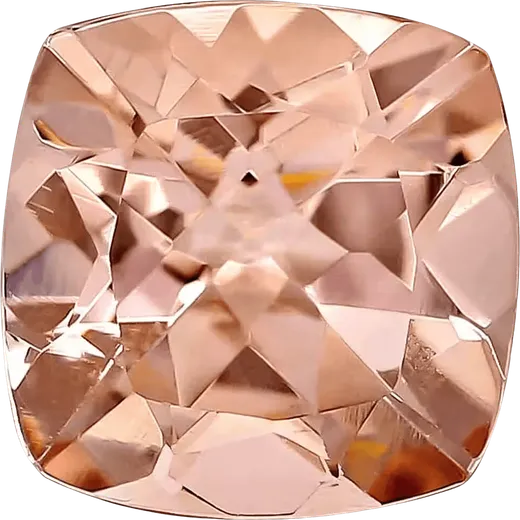
Morganite
Pink beryl, sister to aquamarine and emerald — soft, large and affordable, the tender new favourite for engagement rings in recent years.
Morganite is pink beryl, coloured by manganese, Mohs hardness 7.5–8, sharing its family and hardness with aquamarine. Almost all on the market are gently heated to drive off the orange and leave a purer pink, with stable, unfading colour. Soft, large and affordable, it is the tender new favourite for engagement rings in recent years.
About Morganite
Morganite is the pink-to-peach variety of beryl, coloured by manganese, Mohs hardness 7.5–8, usually clear and hard-wearing. It shares its family with aquamarine and emerald. Its tones run from a bare pink and rose-pink to an orange-tinged peach — soft and unassuming.
Why Choose a Morganite
Morganite’s soft, gentle pink wears beautifully and pairs especially well with rose gold — in recent years a tender alternative to diamond for engagement rings. It can grow large and clean at an affordable price, letting you have a big, soft centre stone for a reasonable sum. Ideal for those drawn to nude tones and a gentle air.
History & Famous Stones
Morganite is itself a story told through a name — a pink beryl found in Madagascar in 1910 was named in 1911 by the Tiffany gemologist George Kunz after the American financier J.P. Morgan, in tribute to the great collector. A name, and a giant crystal:
- The name: Kunz chose J.P. Morgan for his patronage of art and science, and for the important gem collections he gave to the American Museum of Natural History.
- The Rose of Maine: a peach-pink giant crystal unearthed in October 1989 at the Bennett Quarry in Maine, USA — about 23 kilograms (50 lb) and over 30 centimetres across, one of the most famous morganite specimens.
The Truth About Morganite
Almost all morganite is gently heated from orange to pink (stable, unfading); untreated stones lean orange-pink; pale colour is the norm, and saturated stones are dearer.
- Truth one: almost all are heated. Most morganite is heated at low temperature (about 400°C) to drive off the orange-yellow and leave a purer pink — an accepted trade norm.
- Truth two: the heated pink is stable and unfading. It will not change under normal wear, so heating does not lower its value and instead reassures buyers.
- Truth three: natural, untreated stones lean orange-pink or peach; a pure pink usually comes from heating.
- Truth four: pale colour is the norm, and a saturated, not-too-light pink is where the value lies.
Morganite on the Market
Watch for pale stones sold as saturated, and for confusion with pink glass, synthetic spinel, pink topaz and rose quartz.
| Type | Traits | Price | How to tell |
|---|---|---|---|
| Natural · heated | Pure pink, stable colour | Standard | Heating is normal |
| Pale sold as saturated | Shows colour under lamps | — | Check saturation in daylight |
| Pink glass / synthetic spinel | Flat colour, gas bubbles | Low | Bubbles, lacks clarity |
| Pink topaz / rose quartz confusion | Similar colour | Varies | Different mineral and refraction |
Before You Buy
Choose a saturated pink (judged in daylight); heating you can accept with confidence; avoid ultrasonic if there are obvious fractures.
- Colour: a saturated pink wears better and holds value better than a pale one.
- Heating you can accept with confidence; unlike some stones, it does not fade.
- Hard enough — warm water and a soft brush; avoid ultrasonic if obviously fractured.
- Its colour is naturally light and shows well under lamps — look again in daylight before buying.
FAQ
Is heating a morganite normal?
Yes. Almost all on the market are gently heated (about 400°C) from orange to a purer pink, with stable, unfading colour — an accepted trade norm.
Does morganite fade?
No. The heated pink is stable and will not change under normal wear — which is exactly why heating reassures buyers.
How do I tell morganite from rose quartz or pink topaz?
Similar in colour but different minerals — morganite is beryl and clearer; check the refraction and mineral traits, and test it if unsure.
Is morganite a birthstone?
Not a traditional birthstone, but hugely popular lately thanks to the soft-pink-with-rose-gold engagement-ring trend.
How do I choose morganite colour?
A saturated, not-too-pale pink wears best and holds value best; its colour is naturally light, so confirm the saturation in daylight.