
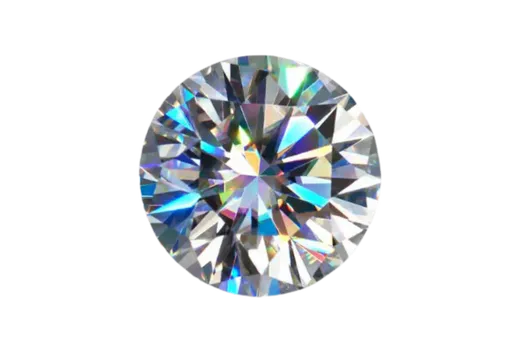
Moissanite
Moissanite is not a "fake diamond" but another mineral — silicon carbide; at hardness 9.25 with more fire than a diamond, it is an honest, clever choice.
Moissanite is not a “fake diamond” but another mineral — silicon carbide, Mohs hardness 9.25, with more fire than a diamond. Natural moissanite is extremely rare, and virtually all on the market is lab-grown. It is honest and rewarding — provided no one has sold it to you as a diamond.
About Moissanite
Moissanite is silicon carbide, Mohs hardness 9.25, with a higher refractive index than diamond; natural stones are extremely rare, and virtually all on the market is lab-grown. It was first found in a meteorite, hence the rarity of natural stones. Second only to diamond in hardness and highly scratch-resistant, its refractive index of 2.65–2.69 exceeds diamond’s 2.42.
Why Choose a Moissanite
Moissanite gives more fire than a diamond at a very affordable price, and is hard enough to wear every day without a second thought. Whether you want a large, sparkling centre stone on a budget, or a “stand-in” to wear while travelling, it does the job honestly — it need not pretend to be anything else, being captivating in its own right.
The Truth About Moissanite
Moissanite has more fire than a diamond, is a gem in its own right and not an imitation, is spotted at a glance by those who know, and its value is in wearing, not resale.
- Truth one: more fire than a diamond. Dispersion of 0.104, over twice diamond’s (0.044); the “rainbow flash” comes from this.
- Truth two: a gem in its own right, not an imitation diamond. Built of silicon carbide, a different thing from carbon-built diamond.
- Truth three: spotted at a glance by those who know. Precisely because the fire is excessive, professionals often recognise it by that “too much spectrum”; a dedicated tester also tells.
- Truth four: its value is in wearing, not resale. It is honest and durable, but has none of a diamond’s rarity premium.
Moissanite on the Market
Tell apart “disclosed moissanite” and “moissanite sold as diamond”; old heat-conduction diamond testers misjudge it, so use a dual tester.
| Type | Traits | Price | How to tell |
|---|---|---|---|
| Disclosed moissanite | Honest, plenty of fire | Affordable | Rainbow flash, dual tester |
| Moissanite sold as diamond | Posing as diamond | A trap | Dual tester (not an old heat tester) |
| Near-colourless vs faint yellow | Different colour grades | Varies | Check colour grade, face-up against white |
Before You Buy
Confirm it is moissanite (not sold as a diamond at a high price); tell it apart with a dual tester, and choose a near-colourless stone.
- If someone offers it under the name “diamond” yet sells it cheap, the alarm is already ringing.
- To tell it from a diamond, use a dual tester — do not trust an old heat-only tester.
- Choose a near-colourless stone; the fire is strong, but a yellow tinge loses points.
- It is hard and hard-wearing, but still avoid heavy blows — as with any gem.
FAQ
Is moissanite a fake diamond?
No. It is silicon carbide, a gem in its own right, and a different thing from carbon-built diamond; it need not pretend to be a diamond.
How do you tell moissanite from a diamond?
Moissanite's fire is excessive, a "rainbow flash" a professional spots at a glance; a moissanite/diamond dual tester confirms it — do not trust old testers that only read heat conduction.
Does moissanite yellow?
Fine near-colourless moissanite is colour-stable; early material could lean yellow-green, so just check the colour grade when buying.
Does moissanite hold value?
It has none of a diamond's rarity premium, so do not believe "it holds value" — its worth is in being honest, hard-wearing and full of fire.
Is moissanite durable?
At hardness 9.25, second only to diamond, it is highly scratch-resistant and very suited to daily wear, though still avoid heavy blows.