
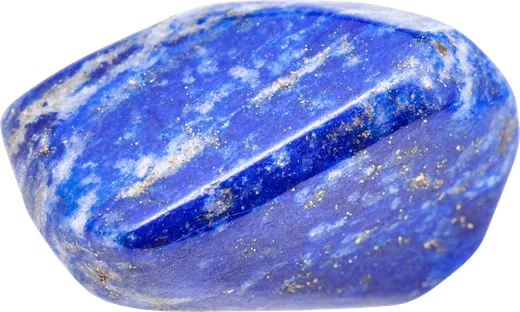
Lapis Lazuli
Lapis lazuli is not a single mineral but a "rock" — deep-blue lazurite, golden flecks of pyrite, white calcite; those gold flecks are its signature night sky.
Lapis lazuli is a blue rock built mostly of lazurite, shot with golden flecks of pyrite and white patches of calcite, Mohs hardness 5–6. The finest is a rich royal blue, low and even in white, with well-placed gold. Since antiquity it was the source of the pigment “ultramarine”, and Afghan material is the most famous; dyeing and waxing are common on the market, so buy with care.
About Lapis Lazuli
Lapis lazuli is not a single mineral but a rock — mostly blue lazurite (about 25–40%), often with pyrite (gold flecks) and calcite (white patches). Its blue comes from sulphur within the lazurite, ranging from a pure ultramarine to a paler blue. Mohs hardness 5–6, and because it is made of several minerals, texture and hardness vary with composition.
Why Choose a Lapis Lazuli
Lapis lazuli’s rich royal blue, scattered with gold like stars in a night sky, has symbolised wisdom and nobility since antiquity — a blue spanning thousands of years of civilisation. From the gold masks of Egypt’s pharaohs to the precious “ultramarine” of Renaissance paintings, lapis has always been the colour of power and the sacred. If you want a deep blue with weight and history, it is one of a kind.
History & Famous Stones
Lapis lazuli is one of humanity’s oldest gems — Afghanistan’s Sar-e-Sang mines have been worked for over nine thousand years, the longest continuously mined site on earth; that ultramarine blue spans thousands of years of civilisation. Two histories tell the weight of this blue:
- Tutankhamun’s gold mask: the blue on the pharaoh’s mask is lapis lazuli from Afghanistan — in the 14th century BCE, Egyptian artisans could obtain lapis from thousands of kilometres away, proof of a remarkable ancient trade route.
- The pigment “ultramarine”: from the Middle Ages through the Renaissance, lapis was ground into ultramarine, a pigment so stable and prized it cost more by weight than gold — the most precious blue in the great paintings.
The Truth About Lapis Lazuli
Top lapis is judged on deep blue, little and even white, and well-placed gold; dyeing and waxing are common, and it is porous and easily harmed by water and chemicals.
- Truth one: the gold flecks are a signature, not a flaw. They are pyrite, and well-judged flecks add to a stone; too many, in patches, lower the value.
- Truth two: the amount of white sets the grade. The less and more even the calcite white, and the deeper and more even the blue, the dearer; grey-mottled stones rank below.
- Truth three: dyeing and waxing are common. Being porous, it is often dyed to deepen the blue, then waxed or resined to fix colour and hide white — the dye may bleed in water.
- Truth four: origin. Sar-e-Sang in Afghanistan yields the most famous deep-blue material, with over six thousand years of history.
Lapis Lazuli on the Market
Tell apart natural, dyed-and-waxed, and other materials (such as dyed calcite or glass) posing as it.
| Type | Traits | Price | How to tell |
|---|---|---|---|
| Natural lapis (Afghan) | Deep blue, gold flecks, little white | High | Even colour, natural pyrite |
| Dyed / waxed | Too-even blue, hidden white | Low–mid | Cotton with acetone may lift colour |
| Dyed calcite posing | Loose texture, floating colour | Low | Low hardness, wrong composition |
| Glass / reconstituted | Too even, contrived flecks | Low | Gas bubbles, too-regular gold |
Before You Buy
Judge lapis on deep blue, little white and well-placed gold, and ask whether it is dyed and waxed; it is porous and wary of water and chemicals, so no ultrasonic, only a soft cloth.
- Colour: a rich royal blue, little and even white, well-placed gold flecks is best.
- Ask about dyeing and waxing — dyed material may bleed colour.
- Porous and wary of water and chemicals: avoid perfume, cosmetics and cleaners, and do not soak it.
- Clean only with a barely-damp soft cloth, never ultrasonic or steam; store apart from harder stones.
FAQ
What are the gold flecks on lapis? Are they flaws?
They are pyrite, lapis lazuli's natural signature; well-judged gold flecks add to it, though too many, in patches, lower the value.
Is lapis dyed?
Plenty on the market is dyed to deepen the blue, then waxed or resined to fix it and hide the white. Natural deep-blue material (such as Afghan) is more prized; ask about dyeing when buying.
What counts as good lapis?
A rich royal blue, as little and even white calcite as possible, and well-placed pyrite flecks are best; grey-and-white mottled stones rank below.
Can lapis touch water?
Best not. It is porous, and long soaking or contact with chemicals can bleed the dye and damage the texture; take it off before hand-washing or bathing.
How do I clean lapis?
Wipe gently with a barely-damp soft cloth; never ultrasonic, steam or chemical cleaners, and store it apart from harder stones.