
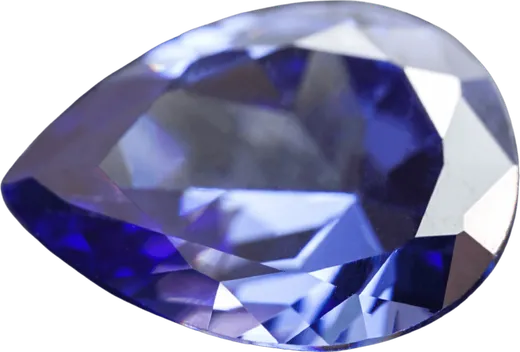
Iolite
Iolite is known for strong pleochroism — turn it and it shifts from blue to near colourless. The Vikings used it as a sun compass, and it is almost never treated.
Iolite is the gem variety of cordierite, Mohs hardness 7–7.5, blue to blue-violet, famed for very strong pleochroism — turn it and it shifts from blue to grey to near colourless. It is almost never treated, nicknamed “water sapphire”, affordable, and a charming alternative to sapphire.
About Iolite
Iolite is the gem variety of cordierite, blue to blue-violet, Mohs hardness 7–7.5, known for exceptionally strong pleochroism. From different angles, one stone shows blue, violet, grey, even near colourless. Its other names — “water sapphire” and “dichroite” (two-colour stone) — say everything about that shifting blue.
Why Choose an Iolite
Iolite offers a sapphire-like blue at an affordable price, and carries a Viking seafaring legend — a stone with a story that is easy on the wallet. The Vikings are said to have used it as a “sun compass” — through its pleochroism, they could locate the sun on overcast days or after sunset. That “blue that points the way” gives it a romance beyond an ordinary substitute.
History & Famous Stones
Iolite’s most legendary identity is the “Viking’s Compass” — Norse seafarers are said to have used its shifting blue to locate the sun on overcast days and after sunset. It has few royal named stones, but a seafaring legend instead:
- The Viking’s Compass: the Danish archaeologist Thorkild Ramskou traced a Viking “sunstone” through the Norse sagas; cut thin, iolite acts like a polarising filter, cutting haze to pinpoint the sun — one of the strongest candidates, though hard proof is still lacking.
- The name: “iolite” comes from the Greek ios (violet), for that shifting blue-violet. Its romance lies not in a price but in a legend that points the way.
The Truth About Iolite
Iolite is almost never treated, a rare natural choice; but its strong pleochroism must be tamed by the cut, and it dislikes heat.
- Truth one: almost no treatment. Unlike sapphire and tanzanite, iolite rarely sees heat, irradiation or dye on the market — natural is its beauty.
- Truth two: the cut is decisive. With pleochroism this strong, the cutter must set the bluest direction upward; get the orientation wrong and the stone leans grey.
- Truth three: it fears heat and thermal shock. Sensitive to high heat and temperature swings — no steam or ultrasonic cleaning.
- Truth four: it is a substitute, not a fake. It travels under the name “water sapphire”, but is a distinct mineral, honest and self-sufficient.
Iolite on the Market
Iolite is mostly natural; watch for confusion with sapphire, tanzanite and glass, and for greyish, poorly-cut stones.
| Type | Traits | Price | How to tell |
|---|---|---|---|
| Natural iolite | Blue-violet, strong pleochroism | Affordable | Clear colour shift when turned |
| Sapphire / tanzanite confusion | Similar colour | Higher | Refraction, hardness, certificate |
| Blue glass imitation | Lifeless, no pleochroism | Low | Gas bubbles, single colour |
| Greyish, poorly-cut | Face-up grey and dull | Low | Not blue enough face-up |
Before You Buy
Check the face-up blue (the cut orientation); it is almost never treated; the material dislikes heat, so clean with warm water and a soft cloth, no ultrasonic or steam.
- Look face-up: a good iolite is clear blue face-up; a greyish one is usually poorly oriented in the cut.
- Almost no treatment — the reassuring reason to choose it.
- It fears heat and thermal shock: no steam, no ultrasonic, no sudden hot and cold.
- Hard enough for everyday jewellery, but still avoid heavy blows.
FAQ
Is iolite a sapphire?
No. Its nickname "water sapphire" comes only from the similar blue; it is really cordierite, a distinct and more affordable mineral.
Why does iolite change colour when you turn it?
Because of its very strong pleochroism — different crystal directions absorb light differently, so you see blue, grey and near-colourless.
Is iolite treated?
Almost never. It rarely sees heating, dyeing or irradiation on the market — a rare naturally-as-is member.
How do I care for iolite?
Warm water and a soft cloth; it dislikes heat and temperature change, so no ultrasonic or steam, and avoid sudden hot and cold.
What counts as a good iolite?
A face-up blue that is clear and not greyish — the cut has set the bluest direction upward; this matters more than size alone.