Green Diamond
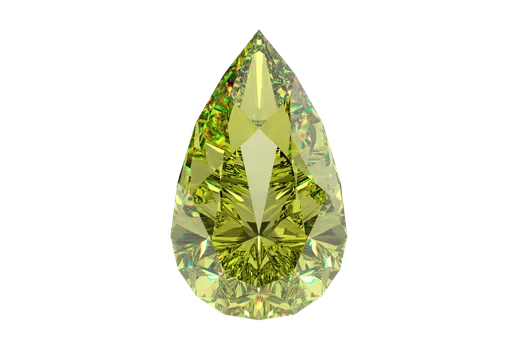
A green diamond's green comes from natural radiation over geological ages, its colour often only skin-deep, and extremely rare; it is also the hardest diamond to identify — because natural and man-made irradiation share the same origin.
A green diamond is pure carbon (hardness 10), its green from natural radiation over geological ages, and its colour often only at the skin. It is extremely rare, and the hardest diamond to identify — because natural colour and man-made irradiation share the same origin, GIA itself calls it “a beautiful problem”. A top certificate is its only proof.
About Green Diamond
A green diamond is a diamond (pure carbon, hardness 10), its green formed by natural radiation irradiating the crystal over long geological ages, the colour often existing only at the skin. When a diamond lies for ages beside radioactive minerals underground, the radiation alters its surface atomic structure and stains it green. For this reason, a natural green diamond’s colour is mostly a “skin colour” — a careless cut can polish it away, which makes a natural green diamond keeping its original colour especially rare.
Why Choose a Green Diamond
A green diamond is an extremely rare and mysterious presence — that green, born of time and radiation, is a collector’s legend. Its green is calm and deep, with a mystery from the earth’s heart and from time. The historic “Dresden Green” is itself a natural green diamond, adding centuries of legend.
History & Famous Stones
Green sits at the rarest end of the fancy colours, and its legend is led by one historic stone — the Dresden Green. A few green diamonds tell the whole story of this rarest hue:
- The Dresden Green: 40.70 carats, natural Fancy Green, from India’s Golconda, over three centuries old, an even apple-green — now in the Grünes Gewölbe (Green Vault) in Dresden, Germany, the most famous green diamond of all.
- The Aurora Green: 5.03 carats, Fancy Vivid Green, sold in 2016 for US$16.8 million — about US$3.3 million per carat, a per-carat record for a green.
- The Ocean Dream: 5.51 carats, Fancy Vivid blue-green, sold for US$8.6 million in 2014.
The Truth About Green Diamond
A green diamond’s natural colour and man-made irradiation share the same origin and are exceedingly hard to tell apart, making it the hardest diamond to identify; the colour is mostly at the skin, and a top certificate is the only proof.
- Truth one: the colour comes from natural radiation. This is what most sets it apart from other fancy diamonds — not an impurity, not pressure, but radiation over time.
- Truth two: the colour is often only at the skin. A natural green is mostly a skin colour, at the surface, and cutting can affect or even remove it.
- Truth three: the hardest to identify. Because man-made irradiation creates green by the same cause as nature, even GIA treats green-diamond identification as “a beautiful problem”, needing the most advanced laboratories.
- Truth four: natural stones are auction level. A green diamond confirmed natural and keeping its original colour is exceedingly rare, among auction and collector pieces.
Green Diamond on the Market
Most “green diamonds” are artificially irradiated; natural green diamonds are exceedingly rare; because the two share an origin, only a top laboratory certificate can tell them apart.
| Type | Traits | Price | How to tell |
|---|---|---|---|
| Natural green diamond | Natural radiation, skin colour | Auction level | Top certificate (GIA) determines |
| Artificially irradiated green | Lab-irradiated to green | Low | Certificate reads “Treated / Irradiated” |
| Green lab-grown | Laboratory, same composition | Low–mid | Girdle “LABORATORY-GROWN” |
| Green imitation | Not diamond | Very low | Hardness, fire, certificate |
Before You Buy
Buying a green diamond demands a top laboratory (GIA) certificate confirming “natural”; because natural and irradiated share an origin and are hard to tell apart, never buy at a natural price without a top certificate.
- Insist on a top certificate (GIA), clearly determining natural versus artificially irradiated — the most crucial step for a green diamond.
- Understand that natural green diamonds are exceedingly rare, at auction level; a “cheap green diamond” is almost certainly irradiated or lab-grown.
- Natural, irradiated and lab-grown can look nearly identical — only a top certificate proves it.
- If you seek the green itself rather than rarity, an irradiated or lab-grown green is an honest and affordable choice — but know it honestly.
FAQ
Where does a green diamond's green come from?
From natural radiation over geological ages irradiating the crystal, changing its surface atomic structure into green; the colour is often only at the skin.
Why is green the hardest diamond to identify?
Because man-made irradiation creates green by the same cause as nature, the two are hard to tell apart; even GIA calls green-diamond identification "a beautiful problem", needing the most advanced laboratories.
Are most green diamonds on the market real?
Most are artificially irradiated green diamonds; natural green diamonds are extremely rare, at auction level. Without a top certificate, do not buy at a natural price.
What is the Dresden Green?
A famous natural green diamond of several centuries' history, an emblem of the green-diamond legend.
How do I choose a green diamond?
A top laboratory certificate determining natural status is an absolute prerequisite; if you only want the green, irradiated or lab-grown greens are affordable, but you must know honestly what you are getting.