
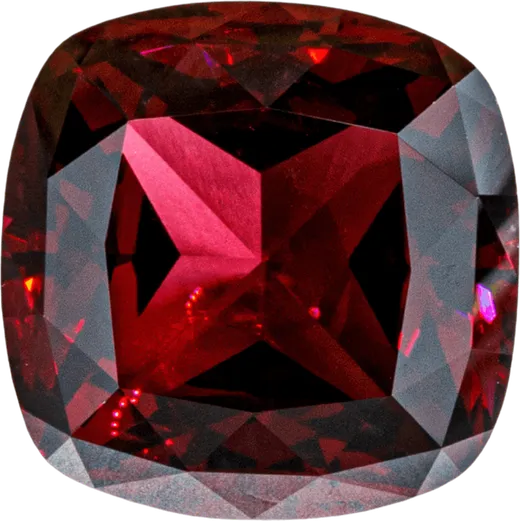
Garnet
Garnet is not only dark red — it is a colourful family, and the great majority are natural and untreated, a rare case of "what you see is what you get".
Garnet is not only dark red — it is a mineral family (almandine, pyrope, rhodolite, spessartine, tsavorite, demantoid), Mohs hardness 6.5–7.5, and the great majority are natural and untreated: a rare case of “what you see is what you get”. It is January’s birthstone.
About Garnet
Garnet is not a single mineral but a family sharing one structure across differing compositions, hardness about 6.5–7.5. Common members: dark-red almandine, pure-red pyrope, rose-purple rhodolite, orange-to-orangey-red spessartine, and the green tsavorite and demantoid.
Why Choose a Garnet
Garnet is January’s birthstone, a symbol of loyalty, friendship and a safe return; its charm is its many faces — one name holding a whole palette. Want an orange-red brightness? There is spessartine. A rose-purple? Rhodolite. A green close to emerald yet more durable? Tsavorite. Its red is a warm, deep wine-red.
History & Famous Stones
Garnet is a family that runs from imperial Russia to Victorian Europe — from the Russian demantoid beloved of the Tsar’s court to the Bohemian pyrope that swept the Continent, each has its own history. Three names tell the whole spread of this family:
- Russian demantoid: discovered in 1853 in the Ural Mountains, its fire so striking it was prized in the Tsar’s court; the master Fabergé set it in imperial Easter eggs and jewellery.
- Bohemian garnet: mined in Bohemia (today the Czech Republic) from around 1500; in the Victorian era, jewellery densely set with small pyropes swept all of Europe.
- Tsavorite: found in 1967 by the geologist Campbell Bridges in Tanzania, then again near Kenya’s Tsavo National Park, and named by Bridges with Tiffany — the youngest and most prized green of the garnet family.
The Truth About Garnet
The great majority are natural and untreated (rare among coloured stones); the green tsavorite and demantoid are the noble end; “what you see is what you get”.
- Truth one: the great majority are untreated. Unlike ruby, sapphire and emerald, so often heated or oiled, garnet comes to you almost always in its natural state.
- Truth two: green garnet is the noble end. Tsavorite and demantoid are rare and costly; the latter is famed for “horsetail” inclusions and exceptional fire.
- Truth three: “what you see is what you get”. Precisely because treatment is rare, the colour before you is usually its own.
- Truth four: occasional fracture filling. A very few have surface fractures filled with a glassy material; rare, but worth watching for disclosure on a costly stone.
Garnet on the Market
Tell apart natural garnet, glass imitation, and synthetics posing as the rare green garnets.
| Type | Traits | Price | How to tell |
|---|---|---|---|
| Natural garnet (mostly untreated) | True colour, natural | By species | What you see is what you get |
| Glass imitation | Gas bubbles, low refraction | Low | Loupe shows bubbles |
| Synthetic YAG etc. as green garnet | Poses as tsavorite | — | Certificate |
| Fracture-filled (rare) | Added clarity | — | Verify on a costly stone |
Before You Buy
Know the species first (dark-red almandine and green tsavorite are worlds apart in price); mostly untreated, but still get a certificate for a costly green garnet.
- Know the species: under one name “garnet”, almandine and tsavorite can be worlds apart in price.
- Untreated as a rule — its reassuring quality; but for a costly green garnet, still ask for a certificate.
- Medium-high hardness — warm water and a soft brush; avoid ultrasonic if obviously included.
- Colour: red should be true, green should be vivid; avoid stones that lean black or muddy.
FAQ
Is garnet only dark red?
No. It is a family — besides dark-red almandine, there is orangey-red spessartine, rose-purple rhodolite, and the green tsavorite and demantoid.
Does garnet need treatment?
The great majority are natural and untreated — remarkable among coloured stones. The colour before you is usually its own.
What is green garnet?
Tsavorite and demantoid — rare and costly; demantoid is famed for its "horsetail" inclusions and exceptional fire.
Which garnet is the most expensive?
Generally the green demantoid and tsavorite, far above the common dark-red almandine.
How do I care for garnet?
Warm water and a soft brush; avoid ultrasonic if there are obvious inclusions, and store it apart from harder stones.