
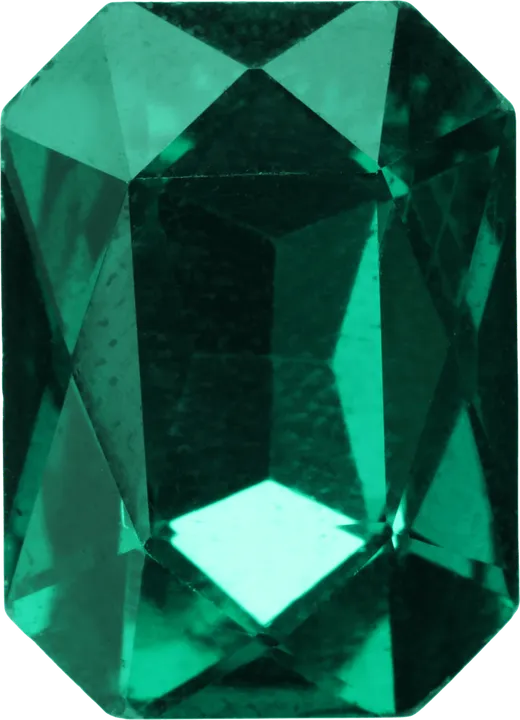
Emerald
An emerald's inclusions are not flaws but its signature — the trade calls them the "garden". Yet it is a delicate stone, and how you wear and care for it is something to know before you buy.
Emerald is the green variety of beryl, coloured by chromium or vanadium, Mohs hardness 7.5–8 — the most delicate of the three great coloured gemstones. It is usually included (the trade calls this the jardin, or garden) and tender by nature; oiling has been standard practice for over a century, and a perfectly clean emerald is, in fact, suspect. It is May’s birthstone.
About Emerald
Emerald is beryl (a beryllium aluminium silicate), turned green by chromium or vanadium, Mohs hardness 7.5–8 — the most delicate of the three great coloured gemstones. It shares its family with aquamarine. That green — deep, saturated, alive — is one no other stone quite imitates.
Why Choose an Emerald
Emerald is May’s birthstone, and its deep green is one of a kind; its inclusions are its signature, the trade’s jardin, or “garden”. Since antiquity it has been the stone of emperors and nobility, carrying a classical, stately air. A wholly clean emerald is, paradoxically, suspect — too clean, and it may be synthetic.
History & Famous Stones
Emerald has been the stone of emperors and nobility since antiquity — from Cleopatra’s mines in ancient Egypt to Colombia’s Muzo and Chivor today, that deep green has always been the colour of power and legend. A few great emeralds tell the whole story of the stone’s weight:
- The Rockefeller Emerald: 18.04 carats, a Colombian emerald sold in 2017 for about US$5.5 million — a record price per carat for an emerald.
- The Duke of Devonshire Emerald: 1,383.93 carats uncut, from Colombia’s famed Muzo mines, considered priceless and now in the Natural History Museum in London.
- The Patricia Emerald: 632 carats, a natural crystal found in Colombia in 1920, rarely kept in its original twelve-sided crystal form, now at the American Museum of Natural History.
The Truth About Emerald
Oiling is a century-old norm (the amount must be declared); “too clean” is suspect (possibly synthetic); it is delicate, and never for ultrasonic.
- Truth one: oiling is a century-old norm. Cedar oil is worked into the fractures to make the stone appear clearer; declared honestly and light in amount, it is normal trade.
- Truth two: the oil grade moves the value greatly. A certificate notes the amount (none / minor / moderate / significant) — if you cannot read that line, do not rush to pay.
- Truth three: “too clean” is suspect. Synthetic emerald is a mature technology and hard to spot by eye; rely on a certificate.
- Truth four: it is delicate by nature, not by fault — accept its tenderness, and it will stay with you.
Emerald on the Market
Tell apart natural (declared oiling), resin-filled, synthetic and dyed-and-injected; it comes down to the oil grade and whether it is synthetic.
| Type | Traits | Price | How to tell |
|---|---|---|---|
| Natural · declared oiling | Garden inclusions, cedar oil | High | Certificate grades the oil |
| Resin-filled | Synthetic resin in fractures | Low–mid | Resin ages and discolours |
| Synthetic emerald | Too clean, too perfect | Low | Certificate, inclusion traits |
| Dyed, injected poor rough | Low-grade rough dyed green | Low | Dye pools in the fractures |
Before You Buy
An emerald must not meet ultrasonic or steam (they drive out the oil); check the oil grade and whether it is synthetic; clean only with warm water and a soft cloth.
- An emerald must never go in ultrasonic or steam cleaning — it drives out the oil and opens the fractures.
- Read the oil grade and whether it is synthetic; these two set its worth.
- Avoid knocks and sudden temperature change; it is far more delicate than the corundum family.
- What you buy is that green and that garden — accept its tenderness, and it will last.
FAQ
Why does an emerald have so many fractures and inclusions?
That is its nature — the trade calls it the jardin (garden), a signature rather than a fault. A perfectly clean emerald should instead raise suspicion, as it may be synthetic.
Is oiling an emerald normal?
Yes. Oiling has been standard practice for over a century; honestly declared and light in amount, it is legitimate trade. A certificate grades the amount as none, minor, moderate or significant.
Can I clean an emerald with ultrasonic?
Never. Ultrasonic and steam shake the oil out and open the fractures — clean only with warm water and a soft cloth.
Is a very clean emerald a good thing?
Not necessarily. Natural emerald is usually included; too clean is suspect and may be synthetic, so confirm by certificate.
How do I care for an emerald?
Wipe gently with warm water and a soft cloth; avoid ultrasonic, steam, knocks and sudden temperature change. It is delicate, so wear it with care.