
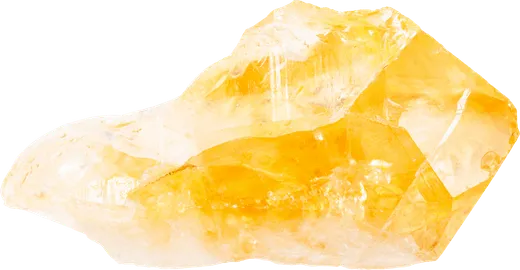
Citrine
Most "citrine" on the market is in fact heated amethyst — natural citrine is far rarer than you would think.
Citrine is yellow quartz, Mohs hardness 7. Most “citrine” on the market is in fact amethyst heated to yellow — natural citrine is far rarer than you would think. This is common knowledge in the trade. It is November’s birthstone.
About Citrine
Citrine is yellow quartz, coloured yellow by traces of iron, hardness 7 with no cleavage, durable and easy to wear; natural stones are scarce, and most on the market is amethyst heated to yellow. It is the same family as amethyst and rose quartz, parted only by trace elements and a history of irradiation.
Why Choose a Citrine
Citrine is November’s birthstone, warm as autumn sun, long nicknamed the “merchant’s stone” for its meaning of wealth and optimism. Hard-wearing and easy to keep, it offers a large, bright warm-toned stone for a reasonable sum — an easy way to add a little sunlight to daily life.
History & Famous Stones
Citrine’s most interesting chapter is its long confusion with yellow topaz — from Scotland’s Cairngorm to the old name “Madeira topaz”, the story runs through it. One fashion, one mix-up:
- Scottish Cairngorm: the citrine of Scotland’s Cairngorm Mountains was set, in the Victorian era, into Scottish dirks, brooches and kilt pins; Queen Victoria’s love of Scottish culture, after buying Balmoral Castle in the 1850s, drove a whole fashion for it.
- The centuries-old topaz mix-up: old names like “Madeira topaz”, “Spanish topaz” and “Scottish topaz” all in fact meant citrine — misleading terms now discouraged by the GIA and others, yet still common in antique jewellery.
The Truth About Citrine
Most citrine on the market is heated from amethyst (open trade knowledge); the tone holds clues (heated leans orange-red, natural a pale lemon); long sun may pale it.
- Truth one: mostly heated from amethyst. Natural citrine is rare, and the mainstream is heat-converted — an open and accepted trade practice.
- Truth two: the tone holds clues. Heated stones often lean orange-red / caramel, natural ones a soft pale lemon-yellow.
- Truth three: often confused with yellow topaz. The names were once used loosely; they are different minerals at different prices.
- Truth four: long sun may pale it. Of the amethyst family, its colour may shift under prolonged strong light.
Citrine on the Market
The mainstream is heated stones (normal, affordable); watch for glass imitation and “wealth” patter inflating the price.
| Type | Traits | Price | How to tell |
|---|---|---|---|
| Heated citrine (from amethyst) | Orange-red / caramel tone | Affordable | Mainstream, and normal |
| Natural citrine | Pale lemon-yellow, soft colour | Slightly higher | Rarer, worth asking about |
| Yellow glass | Gas bubbles | Low | Loupe shows bubbles |
| ”Wealth” patter inflating price | Mysticism | — | Unrelated to gemmology |
Before You Buy
Understand that the mainstream is heated stones (not a trap, but the norm); for natural, judge by colour (a soft lemon-yellow), and avoid long sun.
- Understand the mainstream is heated — not a trap but the norm, and why it is affordable.
- For natural, ask and judge by colour (a soft lemon-yellow is usually natural).
- Avoid prolonged sun and high heat to keep the colour.
- Hard, no cleavage — warm water and a soft brush will clean it.
FAQ
Is citrine baked from amethyst?
Most on the market is — natural citrine is rare, and the mainstream is amethyst or smoky quartz heated to yellow. This is an open and accepted trade practice.
How do you tell natural citrine?
Heated stones often lean orange-red / caramel, natural ones a soft pale lemon-yellow; if you want natural, judge by this and ask.
Does citrine really attract wealth?
Wealth is a cultural meaning, unrelated to gemmology; believe it or not as you like, but it should not sway what you pay for a stone.
Does citrine fade?
Of the amethyst family, its colour may shift under prolonged strong light, so avoid long sun and high heat.
How do I care for citrine?
Warm water and a soft brush; it is hard with no cleavage, but avoid prolonged sun and high heat.