
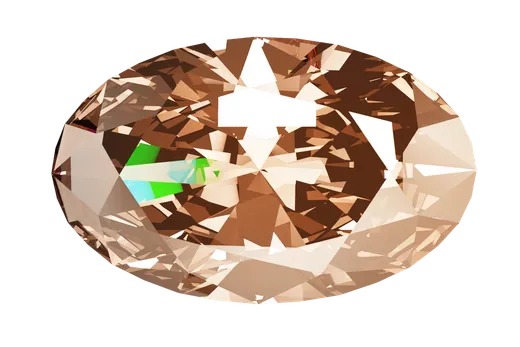
Brown Diamond
A brown diamond's brown comes from nitrogen and lattice defects, the most common and most affordable diamond colour; the trade names and grades it as "champagne" and "cognac".
A brown diamond is pure carbon (hardness 10), its brown from traces of nitrogen and lattice defects (plastic deformation). It is the most common and most affordable diamond colour, and the trade names and grades it as “champagne” and “cognac”. From once being seen as industrial material to today’s fashionable choice, it is the most affordable touch of warm colour.
About Brown Diamond
A brown diamond is a diamond (pure carbon, hardness 10), its brown made together by traces of nitrogen and lattice defects (distortion under pressure), the most common diamond colour. Its colour is half from nitrogen, half from structural slippage as the crystal is pressured — which gives it a wide range, from pale champagne and honey-brown to a rich cognac. The trade often describes its light-to-deep range as “C1 to C7” or “champagne / cognac”.
Why Choose a Brown Diamond
A brown diamond is the most affordable real-diamond coloured centre stone — a warm brown like champagne or cognac, understated and enduring, and the same budget buys a larger stone. It has none of the astronomical threshold of pink or blue diamonds, yet is a diamond through and through, hardness 10 and forever bright. That earthy warm brown is understated, vintage and versatile, suited to those drawn to natural tones who want a piece with character for everyday wear. From “waste material” to a fashion favourite, it is itself a story of reversal.
History & Famous Stones
Brown diamonds were once dismissed as industrial “reject” material, until Australia’s Argyle mine rebranded them as “champagne” and “cognac” in the 1980s and made them fashionable — from cast-off to favourite is a story of reversal in itself. And the largest cut diamond in the world is, in fact, a brown:
- The Golden Jubilee: 545.67 carats, Fancy Yellow-Brown, unearthed at South Africa’s Premier mine in 1985 and faceted over several years by the master cutter Gabi Tolkowsky; presented by the people of Thailand to King Bhumibol in 1997 and now part of the Thai Crown Jewels — heavier than the “Great Star of Africa” by over 15 carats, and long the largest cut diamond in the world.
- The Incomparable: 407.48 carats, Fancy Deep Brownish Yellow, one of the largest fancy diamonds ever cut.
The Truth About Brown Diamond
A brown diamond is the most common and cheapest diamond colour; the trade grades it champagne / cognac; natural browns mostly need no treatment, but HPHT can also wash out or deepen the brown.
- Truth one: once treated as industrial material. Brown diamonds were mostly for industrial use, until Argyle repackaged them as “champagne / cognac” and made them fashionable.
- Truth two: the most common, the most affordable. In the fancy-diamond family, brown is the most plentiful and the most approachable in price.
- Truth three: champagne / cognac grading. From light champagne to deep cognac (often marked C1–C7), the deeper and richer each has its admirers.
- Truth four: watch for treatment. Natural browns mostly come in their own colour; but HPHT can “bleach” a brown to colourless, or conversely deepen it — treatment must be declared.
Brown Diamond on the Market
There are natural brown diamonds (champagne / cognac), HPHT-treated stones, brown lab-grown and imitations; the key is the certificate and whether it is natural.
| Type | Traits | Price | How to tell |
|---|---|---|---|
| Natural brown (champagne / cognac) | Own colour, warm brown | Affordable | Certificate marks natural colour |
| HPHT-treated | Bleached or deepened | Varies | Certificate reads “Treated / HPHT” |
| Brown lab-grown | Laboratory | Low–mid | Girdle “LABORATORY-GROWN” |
| Imitation (glass / CZ) | Not diamond | Very low | Hardness, fire, certificate |
Before You Buy
For a brown diamond, look at the champagne / cognac depth and whether it is natural; it is the most affordable real diamond, but still get a certificate and guard against HPHT treatment and imitation.
- Choose the tone: from light champagne to deep cognac, by taste; the more even and bright the better.
- It is affordable, but still a diamond — get a certificate, confirming natural or HPHT-treated.
- For the same budget, a brown diamond buys a larger stone, suited to a “large and coloured” everyday wear.
- Guard against glass / CZ imitation and lab-grown sold mixed in — rely on the certificate.
FAQ
Why is a brown diamond so cheap?
It is the most common diamond colour, plentiful; once seen as industrial material, it is the most affordable of the fancy diamonds — but it is still a real diamond, through and through.
What is the difference between champagne, cognac and brown diamonds?
They are the same thing — "champagne" is a lighter brown, "cognac" a deeper brown, the trade's names for brown diamonds from light to deep.
Does a brown diamond need treatment?
Natural brown diamonds mostly come in their own colour; but the market also has HPHT treatment bleaching browns to colourless or deepening the colour, to be confirmed by certificate.
Is a brown diamond suitable for a wedding ring?
Yes. At hardness 10 and hard-wearing, its understated warm brown wears well, a good choice for a real coloured centre stone on a limited budget.
How do I choose a brown diamond?
Choose the depth from champagne to cognac by taste, check that the colour is even and bright, and get a certificate confirming natural or treated.