
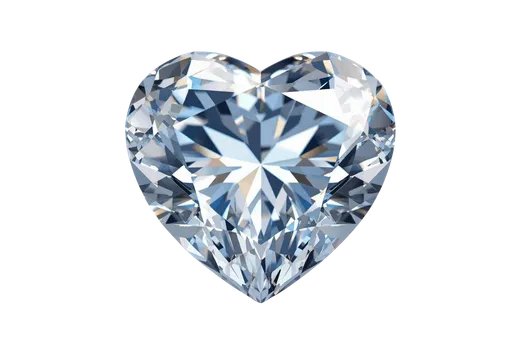
Blue Diamond
A blue diamond's blue comes from traces of boron (Type IIb), and a natural blue diamond even conducts electricity — the only semiconducting gem-grade diamond. The famous Hope Diamond is a blue diamond.
A blue diamond is pure carbon (hardness 10), its blue from traces of boron, a rare Type IIb. A natural blue diamond even conducts electricity — the only semiconducting gem-grade diamond. It is extremely rare — the famous Hope Diamond is a blue diamond. Natural versus irradiated treatment decides its value.
About Blue Diamond
A blue diamond is a diamond bearing traces of boron; boron absorbs red light and turns it blue, a rare Type IIb; a natural blue diamond conducts electricity. Most diamonds hold no boron; once a trace of boron enters the crystal, it absorbs red light and reflects blue, achieving that cool blue. Such diamonds are classed gemmologically as Type IIb, rare and with a curious trait — semiconducting, conducting electricity, which is one clue to a natural blue diamond.
Why Choose a Blue Diamond
A blue diamond is the very image of legend and rarity — the Hope Diamond is a blue diamond, its deep blue calm and mysterious. Its blue is unshowy, yet holds a deep-sea stillness and nobility, at collector and auction level. From the Hope Diamond to the Cullinan Blue, the names of blue diamonds are forever tied to history, legend and fortunes.
History & Famous Stones
The history of the blue diamond is written by one legendary stone — the Hope Diamond, traced to 17th-century Golconda in India, once the French crown’s “French Blue”, stolen in the Revolution and recut into the Hope we know today. A handful of blues are legends of the auction room and the museum:
- The Hope Diamond: 45.52 carats, deep greyish-blue, Type IIb, now in the Smithsonian (donated by Harry Winston in 1958) — its most-visited treasure, and famous for its “curse”.
- The Oppenheimer Blue: 14.62 carats, Fancy Vivid Blue, sold at Christie’s in 2016 for US$57.5 million, once a record for a blue.
- The Blue Moon of Josephine: 12.03 carats, Fancy Vivid Blue, sold for US$48.4 million in 2015, named by a Hong Kong tycoon after his young daughter.
The Truth About Blue Diamond
Natural blue diamonds are coloured by boron and conduct electricity; irradiation and HPHT can turn an ordinary diamond blue, worlds apart in value — the GIA natural colour is the proof.
- Truth one: the blue comes from boron (Type IIb). This is what sets it apart from every blue gemstone, and the root of its rarity.
- Truth two: natural blue diamonds conduct electricity. Being semiconducting is a trait of natural blue diamonds (most irradiated blue diamonds do not conduct).
- Truth three: extremely rare, mostly seen at auction. Natural blue diamonds are very scarce, and the finest keep setting auction records.
- Truth four: natural versus treated is the dividing line. Irradiation or HPHT can make a blue diamond, worth a fraction of natural — always confirm “natural” by GIA certificate.
Blue Diamond on the Market
There are natural blue diamonds, irradiated / HPHT-treated ones, blue lab-grown and blue topaz / spinel posing; prices differ several-fold, and the key is the GIA natural colour.
| Type | Traits | Price | How to tell |
|---|---|---|---|
| Natural blue diamond (Type IIb) | Boron colour, conducts electricity | Auction level | GIA “Natural” + conductivity |
| Treated blue (irradiated / HPHT) | Artificial colour | Low | Certificate reads “Treated” |
| Blue lab-grown | Laboratory, same composition | Low–mid | Girdle “LABORATORY-GROWN” |
| Blue topaz / spinel posing | Not diamond, softer | Very low | Hardness, refraction, certificate |
Before You Buy
Buying a blue diamond demands a GIA certificate confirming “natural colour”, reading the fancy grade and the blue, and guarding against irradiated / HPHT treatment and lab-grown sold mixed in.
- Insist on a GIA (or equivalent) certificate, confirming the colour is natural, not treated.
- Read the fancy grade (Fancy → Intense → Vivid) and whether the blue is pure (little grey, little green).
- Understand that natural blue diamonds are auction-level rare; a “cheap blue diamond” is mostly treated or lab-grown.
- Natural, treated and lab-grown can look nearly identical — only the certificate proves it.
FAQ
Where does a blue diamond's blue come from?
From traces of boron in the crystal — boron absorbs red light and reflects blue, making the diamond blue; these are called Type IIb diamonds.
Is it true blue diamonds conduct electricity?
Yes. Natural blue diamonds are semiconducting and conduct electricity, which is one clue to telling them from most irradiated blue diamonds.
Is the Hope Diamond a blue diamond?
Yes. The famous Hope Diamond is a deep-blue natural blue diamond, and an emblem of the blue-diamond legend.
How do you tell a blue diamond from blue topaz?
A blue diamond is a diamond (hardness 10, Type IIb); topaz is softer with different refraction; worlds apart in value, told apart by certificate and testing.
How do I choose a blue diamond?
A GIA natural-colour certificate is an absolute prerequisite, then the fancy grade and the purity of the blue; it is a rare collectible, and the certificate is its standing.