
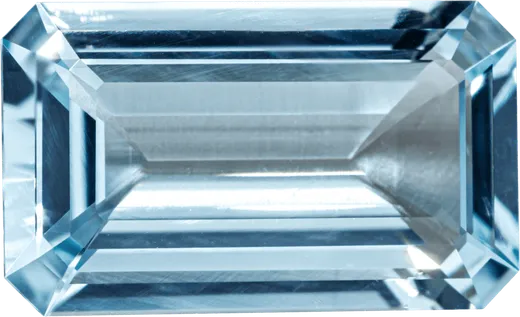
Aquamarine
Kin to emerald, yet far clearer and more durable — aquamarine is the easiest member of the beryl family to live with.
Aquamarine is blue beryl — kin to emerald, yet far clearer and more durable, Mohs hardness 7.5–8. Heating to drive off the green and leave a pure blue is the norm, and the colour is stable and undiminished in value. It is March’s birthstone, made for a fresh air and everyday wear.
About Aquamarine
Aquamarine is blue beryl, kin to emerald and morganite, coloured by traces of iron, hardness 7.5–8, and usually clean and clear. It stands in contrast to its heavily fractured cousin, emerald — few inclusions, high clarity. Its blue ranges from a shallow-water sky-blue to a deep-sea saturated blue.
Why Choose an Aquamarine
Aquamarine is March’s birthstone, blue as a body of seawater, an ancient talisman of sailors promising safe passage and a safe return. Clean, hard-wearing, and able to grow large and clean — it is one of the few beautiful stones that offer “large and clean” at a reasonable price, ideal for a fresh air and daily wear.
History & Famous Stones
Aquamarine has been a sailor’s talisman since antiquity, promising a safe return; that seawater blue grows large and clean, and has become some of the most monumental works in gem history. A few great pieces tell the weight of that blue:
- The Dom Pedro: 10,363 carats, the largest cut aquamarine in the world — carved into a near-36-centimetre obelisk by Bernd Munsteiner, the “father of the fantasy cut”, named after Brazil’s two emperors, and now in the Smithsonian.
- The Roosevelt Aquamarine: 1,298 carats, given by Brazil to the American First Lady Eleanor Roosevelt in 1936.
The Truth About Aquamarine
Heating to a pure blue is the norm and stable (no loss of value); deeper colour is dearer (Santa Maria); beware Maxixe irradiated blue, which fades.
- Truth one: heating is the norm, and stable. Gentle heat drives off the green and leaves a pure blue — standard practice in the aquamarine trade, and the resulting blue is stable.
- Truth two: deeper colour is dearer. Most sought is a medium-to-deep blue with no green; the trade takes the Brazilian Santa Maria mine as its colour benchmark (now a colour grade).
- Truth three: beware Maxixe irradiated blue. An irradiated deep blue looks enchanting at first, but is unstable and fades over time.
- Truth four: it is clean by nature, so heavy inclusions or cloudiness are worth an extra question about the price.
Aquamarine on the Market
Tell apart natural heated (normal), Maxixe irradiated blue (fades) and glass / synthetic-spinel imitation.
| Type | Traits | Price | How to tell |
|---|---|---|---|
| Natural · heated | Pure blue, stable colour | Standard | Heating is normal |
| Maxixe irradiated blue | Deep blue but fades | Low | Must be declared; fades over time |
| Blue glass / synthetic spinel | Lifeless colour | Low | Gas bubbles, colour banding |
| Santa Maria (colour grade) | Medium-deep blue, no green | High | A colour grade, not an origin guarantee |
Before You Buy
Choose a medium-to-deep blue with no green; heating you can accept with confidence, but ask whether it is Maxixe irradiated (which fades).
- Colour: a medium-to-deep blue with no green wears best and holds value best.
- Heating you can accept with confidence; but ask whether it is Maxixe irradiated.
- Hard and tough enough — warm water and a soft brush, and generally fine in ultrasonic (unless obviously fractured).
- Avoid prolonged sun and high heat, lest the colour pale.
FAQ
Is heating an aquamarine normal?
Yes. Heating to drive off the green and leave a pure blue is standard; the resulting blue is stable and does not fade, nor does it lose value.
What is Santa Maria?
A famous Brazilian mine, denoting a medium-to-deep blue with no green; today it is a colour grade, not necessarily an origin.
Does aquamarine fade?
Heated blue is stable and does not fade; but beware Maxixe irradiated blue — that deep blue is unstable and fades over time, and must be declared.
Can aquamarine take ultrasonic cleaning?
Generally yes, unless there are obvious fractures; also avoid prolonged strong light and high heat, which can pale the colour.
How do I choose aquamarine colour?
A medium-to-deep blue with no green wears best and holds value best; too pale or greenish is worth less.