
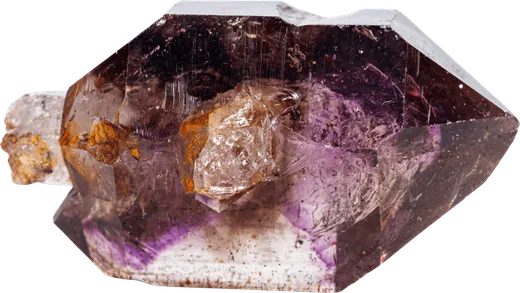
Ametrine
In one stone, amethyst and citrine coexist — natural ametrine comes almost only from a single mine in Bolivia.
Ametrine is the variety in which purple (amethyst) and yellow (citrine) coexist naturally in one quartz crystal, Mohs hardness 7. Natural commercial-grade ametrine comes almost only from the Anahí mine in Bolivia — which gives it an inborn “origin story”.
About Ametrine
Ametrine is the variety in which purple and yellow coexist naturally in one quartz crystal, hardness 7 with no cleavage, coloured by iron in differing oxidation states. Its two colours arise from iron in different regions of the crystal, showing different colours under different oxidation states.
Why Choose an Ametrine
Ametrine’s two colours in one stone, purple and gold meeting and merging, are often read as “two sides of one whole, strength and softness together” — ideal for those who love the unusual or want a gift with a story. Cutters deliberately give purple and gold half each, with a clear boundary — its classic look, and a rare talking point in itself.
History & Famous Stones
Natural commercial ametrine comes almost only from Bolivia’s Anahí mine — and the mine itself is wrapped in a romantic legend. One legend, one revival:
- The legend of Princess Anahí: it is said that in the 17th century the Spanish conquistador Felipe de Urriola y Goitia married Anahí, a princess of the Ayoreo people, and received the mine as her dowry; as she lay dying, she gave him this purple-and-gold stone as a token of eternal love. (The tale is largely a modern marketing invention — take it as legend.)
- From legend to market: ametrine was rediscovered in the 1960s and returned to the market in the 1970s — and the name “Anahí” has travelled with that two-toned stone ever since.
The Truth About Ametrine
Natural ametrine has a highly concentrated origin (Bolivia’s Anahí); the market has man-made bicolour and hydrothermal synthetics; its beauty lies in a crisp boundary and balanced proportions.
- Truth one: natural stones have a highly concentrated origin. Commercial-grade natural ametrine comes almost only from the Anahí mine in Bolivia.
- Truth two: the market has man-made bicolour. Bicolour made by locally heating amethyst or by other means must be told from natural.
- Truth three: synthetics exist too. Hydrothermally synthesised ametrine exists and is hard to tell by eye; low-priced bulk especially warrants care.
- Truth four: the beauty is in the boundary. Whether the two colours are crisp and the proportions balanced is the key to judging it.
Ametrine on the Market
Tell apart natural (Anahí), heat-made bicolour, hydrothermal synthetics and glass mimicking two colours.
| Type | Traits | Price | How to tell |
|---|---|---|---|
| Natural ametrine (Anahí) | Crisp, natural two colours | Standard | Bolivian origin |
| Heat-made bicolour | Artificial boundary | — | Must be declared |
| Hydrothermal synthetic | Hard by eye | Low | Needs instrument testing |
| Glass mimicking two colours | Too-regular boundary | Low | Gas bubbles, contrived |
Before You Buy
Ask whether it is natural or synthetic (natural comes mainly from Bolivia), and look at whether the boundary is crisp and the proportions pleasing.
- Ask natural or synthetic — natural stones come mainly from Bolivia’s Anahí.
- Look at whether the two-colour boundary is crisp and the proportions wear well.
- Of the amethyst family — avoid prolonged sun and high heat to keep the colour.
- Hard, with no cleavage — warm water and a soft brush will clean it.
FAQ
Where does ametrine come from?
Natural commercial-grade ametrine comes almost only from the Anahí mine in Bolivia — its inborn "origin story".
Is ametrine natural?
Both natural and man-made exist — the market has heat-made bicolour and even hydrothermally synthesised ametrine; natural stones come mainly from Bolivia.
How do you spot synthetic ametrine?
Hydrothermal synthesis is hard to tell by eye; low-priced bulk especially warrants care, and testing to confirm if unsure.
Why is ametrine half purple, half yellow?
Because iron in different regions of the same crystal sits in different oxidation states, so purple and yellow appear in one stone.
How do I care for ametrine?
Warm water and a soft brush; being of the amethyst family, avoid prolonged sun and high heat to keep the colour.