
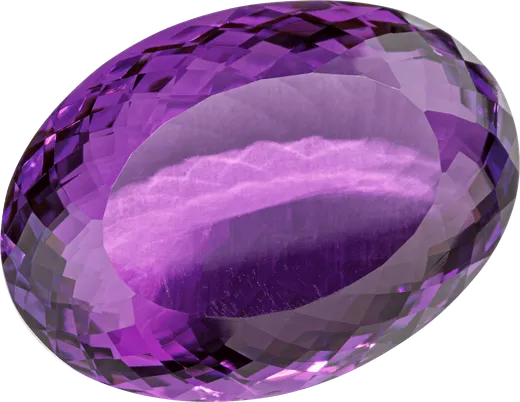
Amethyst
Two centuries ago it ranked with ruby, sapphire and emerald; then Brazil unearthed whole mountains of it, and the price came down. Today it is one of the few beautiful stones that are large, clean and affordable.
Amethyst is purple quartz, Mohs hardness 7. Before the nineteenth century it ranked with ruby, sapphire and emerald among the “five great gems”; a great Brazilian find brought it down to a semi-precious stone — and today it is one of the few beautiful stones that are large, clean and affordable. It is February’s birthstone.
About Amethyst
Amethyst is purple quartz, coloured together by traces of iron and natural irradiation, Mohs hardness 7 with no cleavage, durable and easy to wear. It is the same mineral as rock crystal, citrine and rose quartz, parted only by trace elements and a history of irradiation.
Why Choose an Amethyst
Amethyst is February’s birthstone; it once ranked with the red, blue and green great gems, yet today it is affordable — which is precisely its rare gift. Before the nineteenth century only royalty and the Church could afford it; then large deposits in Brazil and Uruguay brought it down from a top gem to a semi-precious one. It did not get worse — it got affordable.
History & Famous Stones
Amethyst once ranked with diamond, ruby, sapphire and emerald among the “five cardinal gems”, one of medieval Europe’s most noble stones; and its name carries a legend or two. One riddle-stone, one giant geode:
- The Delhi Purple Sapphire: a “sapphire” in name only — in fact an amethyst. Said to have been looted from an Indian temple in 1857, it was thereafter dogged by misfortune; the collector Edward Heron-Allen sealed it inside seven charm-lined boxes and finally left it to the Natural History Museum in London, where it sits in the vault today.
- The Empress of Uruguay: over three metres tall and about 2.5 tonnes, the largest amethyst geode known — miners took three months to free it from the basalt.
The Truth About Amethyst
Amethyst is judged on colour, not clarity; watch for zoning; heating turns it yellow (most citrine comes this way); synthetics are an open problem.
- Truth one: judged on colour, not clarity (it is usually clean). The trade prizes “Siberian” colour most — a deep purple with red-violet flashes, now a colour grade.
- Truth two: watch for zoning. Colour often runs deep here, pale there, and the cutter’s skill is in placing the deepest colour where it shows most.
- Truth three: natural stones are rarely enhanced; but heated amethyst turns yellow, and most citrine on the market comes exactly this way.
- Truth four: synthetic amethyst is an open problem. Hydrothermal synthesis is mature and hard to tell by eye or basic testing.
Amethyst on the Market
Guard against synthetic amethyst and glass / cubic-zirconia imitation, and watch for pale stones sold as deep.
| Type | Traits | Price | How to tell |
|---|---|---|---|
| Natural amethyst | Even colour, usually clean | Affordable | Natural zoning |
| Synthetic amethyst | Hydrothermal, too perfect | Low | Hard by eye, needs instruments |
| Glass / cubic zirconia (CZ) | Glass has bubbles, CZ too bright | Low | Bubbles, over-heavy or over-bright |
| Pale sold as deep | Shows colour under lamps | — | Judge in daylight |
Before You Buy
Amethyst fades in sun — avoid prolonged direct sunlight; otherwise it is easy to keep, cleaned with warm soapy water.
- Amethyst fades in sun: prolonged direct sunlight pales the purple, irreversibly — off the windowsill, and not worn in long sun.
- Beyond that it is easy to keep — hard, no cleavage, warm soapy water will do.
- Look for even colour, from several angles; avoid stones coloured in only one corner.
- Do not pay a cent extra for added mystical claims.
FAQ
Does amethyst fade?
Yes. Prolonged direct sunlight pales the purple, irreversibly — do not leave it on a windowsill or wear it in long sun; ordinary daily wear is fine.
Amethyst is cheap — does that mean poor quality?
No. It was once one of the "five great gems"; a huge Brazilian find flooded supply and dropped the price — today you can have a large, clean, well-coloured stone for a reasonable sum, which is its rare gift.
How do you spot synthetic amethyst?
Hydrothermal synthesis is mature and hard to tell by eye or basic testing — an open problem in the market; low-priced bulk especially warrants care, and testing if unsure.
What is "Siberian" colour?
A deep purple with red-violet flashes, the top colour; today a colour grade, not necessarily an origin.
How do I care for amethyst?
Warm soapy water and a soft brush; it is hard with no cleavage, but avoid prolonged sun and high heat to keep the colour.