
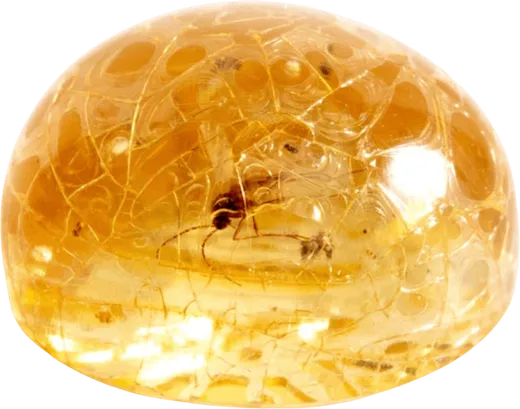
Amber
Amber is fossilised tree resin from tens of millions of years ago — the insects sealed inside are its most precious "time capsule".
Amber is fossilised tree resin from tens of millions of years ago, an organic gem, Mohs hardness just 2–2.5 — one of the softest gems. Baltic amber (succinite) is the most famous, and pieces with an insect inside are especially prized. What to guard against most is pressed amber and copal (young resin) imitation, and its very soft body, wary of chemicals.
About Amber
Amber is fossilised tree resin from tens of millions of years ago, an organic gem rather than a mineral, Mohs hardness just 2–2.5. True amber takes millions to tens of millions of years to bury and polymerise; Baltic succinite is the most famous kind, holding 3–8% succinic acid. It is light, warm and smooth, with a woody familiarity in the hand.
Why Choose an Amber
Amber is the only gem that seals away ancient time — the insect or plant within is a true “time capsule”. Light, warm and comfortable to wear, its colour runs from honey-yellow to brown-red, with a natural sense of life, seen since antiquity as a talisman and a healing thing. If you love a natural object with story and warmth, amber is one of a kind.
History & Famous Stones
Amber’s most legendary chapter is the lost Amber Room — an entire room panelled in amber, hailed as the “Eighth Wonder of the World”, which vanished mysteriously in the Second World War. One room, one enduring mystery:
- The Amber Room: built in 1701–1714 for King Frederick I of Prussia in Danzig (today Gdańsk), given to Tsar Peter I of Russia in 1716 and installed in the Catherine Palace near St Petersburg, later enlarged by Catherine the Great.
- Lost and reborn: in the war, Nazi forces stripped the room in 36 hours, packed it into 27 crates and shipped it to Königsberg; after 1945 it was never seen again — the world’s most famous lost treasure. Russia began a reconstruction in 1979 and, 24 years on, unveiled it anew at the Catherine Palace in 2003.
The Truth About Amber
Amber is very soft and wary of chemicals; the market’s biggest trap is copal (young resin) and pressed amber posing as true fossil amber.
- Truth one: the inclusion is the soul. Natural inclusions — insects, spiders, plant fragments — carry scientific value and set the price; but too-perfect or too-centred inclusions warrant suspicion.
- Truth two: copal posing. Copal is “young resin” (hundreds to thousands of years), not fully fossilised, often sold as amber; the price gap is wide.
- Truth three: pressed (reconstructed) amber. Amber fragments fused under heat and pressure, sometimes mixed with copal — another thing entirely from a single natural piece, and to be declared.
- Truth four: very soft, very wary of chemicals. At just 2–2.5, perfume, alcohol, chemicals and even long sun will harm it.
Amber on the Market
Tell apart true fossil amber, pressed amber, copal and plastic imitation.
| Type | Traits | Price | How to tell |
|---|---|---|---|
| Natural amber | Fossil, light, warm | High | Floats in salt water, builds static when rubbed |
| Pressed amber | Fused fragments, flat texture | Low–mid | Blood-streak flow lines, flattened bubbles |
| Copal (young resin) | Unfossilised, easily dissolved | Low | Tacky with alcohol, strong smell |
| Plastic / glass imitation | Too perfect, too heavy / too light | Low | Glass feels cold, plastic smells burnt |
Before You Buy
Tell true fossil, pressed and copal apart first; it is very soft and wary of chemicals, so avoid perfume, alcohol and ultrasonic, and wipe only with a soft cloth.
- Ask: a single natural piece, pressed, or copal.
- If an inclusion is too perfect or too centred, ask one more question.
- Very soft and wary of chemicals: perfume, hairspray, alcohol, cleaners and ultrasonic all harm it — put it on last, take it off first.
- Wipe only with a dry or barely-damp soft cloth; avoid long sun and high heat.
FAQ
Is amber a stone?
No. Amber is fossilised resin, an organic gem with no mineral crystal, hardness just 2–2.5 — one of the softest gems.
How do you tell amber from copal?
Copal is "young resin" (hundreds to thousands of years), not fully fossilised; a drop of alcohol makes it tacky and heat softens it, while true amber is fossilised and more stable. The price gap is large.
What is pressed amber?
Amber fragments fused under heat and pressure, sometimes mixed with copal; different from a single natural piece, and to be declared when buying.
How do I care for amber?
Very soft and wary of chemicals — keep it from perfume, alcohol, cleaners and ultrasonic; put it on last and take it off first, wipe only with a soft cloth, and avoid strong sun.
Is amber with an insect always expensive?
Natural, clear, rare inclusions do add value; but if it is too perfect or too deliberately placed, beware of implanted or imitation pieces.